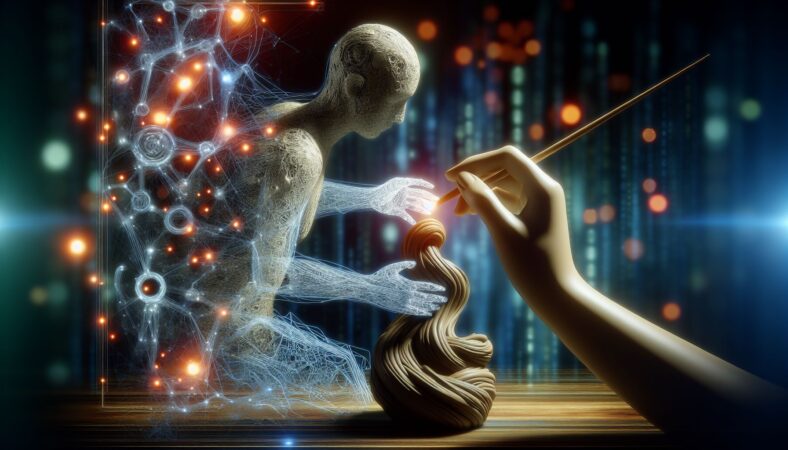
Hello, fellow tech enthusiasts! It’s certainly not an alien concept when I say that technology pervades every corner of our lives. From automated homes, electric vehicles, blockchain, even to the looming prospect of working beside quirky robots, we are living in a fascinating era. But today, let’s park our Teslas and steer clear of Bitcoin price trends for a bit. Let’s chat about an emerging tech trend that’s causing quite the ripples in the world of art—Artificial Intelligence in creative arts.
The Dawn of Algorithmic Artists
Just to toss some history into the mix, AI in creative arts didn’t start yesterday. The seeds were planted back in the 60s and 70s with pioneering artists like Harold Cohen who designed AARON, an autonomous AI program for creating art. Fast forward to today, and AI’s impact on the arts has exploded. We’re now seeing AI-created paintings, music, poetry, dance choreographies, and more!
Remember “Portrait of Edmond De Belamy,” created by the AI model GAN (Generative Adversarial Network)? When it went under the hammer at Christie’s, it sold for a whopping $432,500! If this isn’t the techno-utopian dream we’ve all been fantasizing about, I don’t know what is.
The Mechanics of AI Artistry
So, how exactly does this wizardry work, you ask? The science behind this is quite simple on the surface but complex underneath. AI algorithms and models like GANs are trained on massive amounts of data (artworks, music, literature, etc.) and then generate their own unique, creative pieces.
The result? Take OpenAI’s Jukebox model, which created an entire album mimicking the musical style of Elvis Presley. The King might have left the building, but AI seems capable of filling in his blue suede shoes, don’t you think?
The Grand Dilemma: Originality vs Creativity
Now, let’s dig a little deeper. Can AI truly be creative? This question sparks intense debates. I mean, AI just processes tons of data and pattern-matches its way to generating art. It doesn’t have emotions or creative consciousness, right?
I agree, but then let’s pause here a little and marvel at how well AI has imitated and replicated human creativity! Isn’t that a form of creativity too? As we grapple with this debate, remember, when photography first emerged, people dismissed it as mechanical and soulless. Look where it stands today!
The Artistic AI’s Playground: Opportunities and Challenges
Yesterday, it was Deep Blue beating a Chess Grandmaster, today it’s AI models creating symphonies and paintings. The progression of AI from analytical to creative tasks is genuinely intriguing.
There’s potential for AI to democratize art, making it more accessible to those who may lack the talent but not the passion. AI models can work as creative tools, turning everyone into potential artists. We see this with platforms like Google’s DeepDream and Runway ML, which provide tools for creating AI art.
At the same time, this fusion brings challenges too. Copyright infringement and plagiarism, for starters. If an AI model creates an artwork inspired by Van Gogh’s paintings, who gets credited? Also, as AI becomes more sophisticated, distinguishing between human and AI art could become tricky, impacting the value and perception of art.
A Future Painted with AI
Thinking about the exciting developments and the challenges makes it clear that we are on the cusp of an extraordinary fusion of art and technology. Brace yourselves, folks, the dawn of algorithmic artists is just the beginning.
Tomorrow’s art world might see AI as a creative partner rather than a tool, even witnessing the birth of “hybrid” art, a fusion of human and AI creativity. Wouldn’t that be something? As we step into this era, let’s keep enjoying the magic that AI brings to our artistic realms, much like the careful brushstrokes of a Picasso masterpiece.
Signing off for today, folks. Keep that tech curiosity roaring and never stop marveling at the wonders of our techno-utopian world!