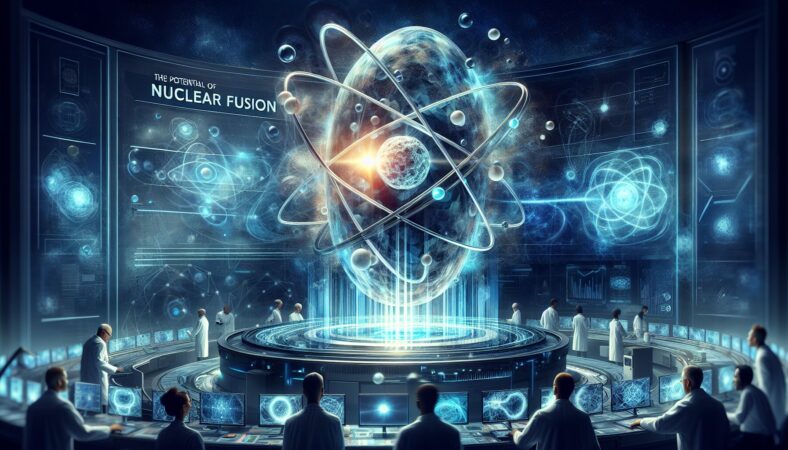
Greetings fellow tech aficionados! Today, we’re going to kick the tires and check under the hood of something truly awesome. It’s an idea that has fueled science fiction fantasies and real-world research for decades. It’s controversial, it’s fascinating, and if it works, it could solve our clean energy conundrum once and for all. Yup, you guessed it – we’re talking about nuclear fusion.
A Quick Primer on Nuclear Fusion
Before we dive deeper (pun totally intended), let me explain nuclear fusion in the simplest terms possible, without the excessive scientific jargon.
Imagine taking two very light atoms, squishing them together under extreme heat and pressure, and producing a heavier atom. Now, because of this funky thing called the Law of Conservation of Mass (thank you, Mr. Einstein), you’re left with some spare energy after your atomic cookout. And when I say ‘some’ energy, I mean a lot.
Fusion specifically involves combining hydrogen atoms to form helium. It’s the process that powers our friendly neighborhood star, the Sun, and it releases energy more efficiently than any source we currently know or harness.
The Promise of Infinite Energy
Now, fusion energy isn’t a new concept. Sci-fi writers have been scribbling about it for years, and it’s always popping up in tech news. But recently, there are rumblings in the industry that put a big “maybe sooner” sticker on it.
Companies and collaborations worldwide are pumping billions of dollars into research and trials. Even the often-standoffish tech titans are coming together. Something like the ITER project, an international fusion collaboration, started decades back but is now starting to look promising.
We’re not any closer to launching a fusion-powered spaceship à la “Star Trek,” but at the speculative end, some folks believe we could build a prototype fusion reactor in a decade or so.
The appeal of nuclear fusion, if we can make it a reality, is hard to overstate. It promises near-infinite energy, with no greenhouse gas emissions, and abundant raw materials available in sea water. You know, just a clean, seemingly unlimited power source that could solve our climate woes. It’s the dream!
The Challenges of Harnessing Sun Power
But why, then, haven’t we been able to bring this sci-fi dream to life? The main reason: it’s technically complex, and understating that is like saying Elon Musk has a tiny interest in space travel.
Fusion requires heating up a gas to over six times the temperature of the Sun’s core, which ain’t a walk in the park, folks. And after you’ve achieved that, you need to control this super-hot plasma and get more energy out than what you put in.
Getting to that point has proven elusive. We’ve seen some brilliant experiments like the recent one at China’s EAST reactor, showing an artificial Sun burning for over 17 minutes, but we’re still chasing the net energy output needed for a power plant.
The Fusion Future
While the timeframe to a fusion future remains uncertain, the strides we’re taking in this decade are encouraging. Just go on and ask anyone at Commonwealth Fusion Systems, a startup spun off from MIT which is already testing components for its first fusion reactor.
I won’t hang my hat on the claim that we’ll be drawing power from fusion reactors within our lifetime. But I am convinced that pursuing this frontier is essential. Wind and solar are huge steps in the right direction, but if we’re serious about tackling climate change and energy scarcity, fusion could be the ace in the hole.
It’s got the dreamer in anyone humming David Bowie’s “Starman,” and with recent strides, maybe it’s not just the sci-fi nerds like me who’re excited.
So here’s to a future filled with clean, abundant energy, however we get there. Whether fusion becomes our holy grail or just an interesting tech adventure, it’s a journey worth following. As always, stay curious and keep an eye on the horizon. Science has a way of surprising us when we least expect it.
Until next time, keep the tech vibe alive!