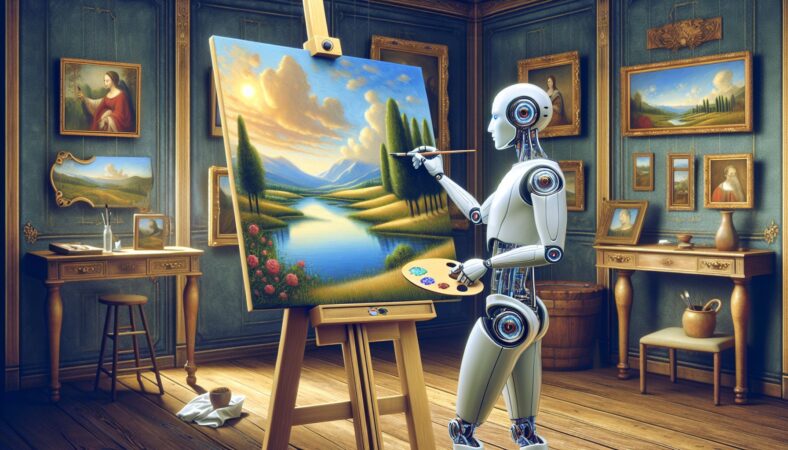
Hello tech comrades!
I just can’t contain my excitement these days and don’t ask me why. Okay, go on, ask me why. Because, my friend, we are living in the golden age of Artificial Intelligence (AI) and it’s transforming everything, including our beloved sector, the creative arts. Kinda intriguing, right?
Let’s take a look today into this world where AI meets the creative arts. Brace yourself, Dorothy. We aren’t in Kansas anymore.
The Dawn of Artistic AI
Admit it. We’ve all doodled in the margins of our notebooks back in school, thinking we’re the Leonardo da Vinci of our time. Plot twist: we weren’t. But guess who could soon become the da Vinci of the AI age? Our one and only pal, AI. Yes, AI’s getting mighty creative these days, playing around with painting, music, writing, and other artistic fields. Companies like OpenAI are extending breakthroughs in technology to touch creativity, producing jaw-dropping results.
Remember when an AI-crafted painting “Portrait of Edmond de Belamy” auctioned for a whopping $432,500 at Christie’s? Or when OpenAI’s MuseNet composed a symphony that sounded as though it were from Mozart himself, only… it wasn’t? These are no mere stunts, but signals of a new chapter in the creative arts.
Dystopian Fears vs Utopian Dreams
Reading this far, you might be picturing a dystopian future where robots overrun artists, stealing their jobs while churning out mass-produced, soulless art. Take a breath, and allow me to paint a different picture, one of possibility and collaboration.
Think of AI as a tool in the hands of artists. An intelligent brush that brings along the depth of a million paintings. A pen infused with the creative wisdom of countless authors. With AI, artists can push their boundaries, explore unprecedented horizons and pull off masterpieces impossible by human hands alone. As for our job security, let’s remember that tools enhance our capabilities, they don’t replace us.
Implications and Challenges
The implications of this AI-art infusion are massive. AI could democratize art, allowing creativity to flourish beyond the traditional artist circles. It could create an art form that’s a perfect blend of human emotions and machine precision, offering a new perspective to our aesthetic senses.
While this is hugely exciting, it ain’t no walk in the park. There are valid challenges we need to tackle. We have to address issues surrounding copyrights and originality. If an AI creates an artwork, who owns it, the code, the coder or the AI? And how do we make sure that AI helps creativity instead of restricting it by creating generic or repetitive art forms? There’s plenty to figure out.
Future Outlook: AI Picasso in the Making?
Where do we head from here? I’d like to imagine a future where AI aids artists, creating a fusion art form that amplifies the beauty of human creativity. A future where you could create your personal AI-assistant, feeding it your creative preferences and letting it generate personalized masterpieces for your eyes only.
However, like any other technology in its infancy, AI’s journey in the creative arts will be as thrilling as it is unpredictable. For all we know, the next Picasso could be an algorithm.
But for now, let’s enjoy the show as the boundaries between art and science blur, wrapping us in a shroud of beautiful uncertainty.
So, that’s that, folks! Our crazy, exciting tour through the world of AI-invaded arts. And remember, this isn’t some science fiction fantasy. It’s happening all around us. AI is tapping into its inner Picasso, and it’s high time we welcomed this new member to our creative family.
Until next time, folks, keep exploring! What we’re seeing now is just the beginning, and honestly, I have no idea where it’s all heading!