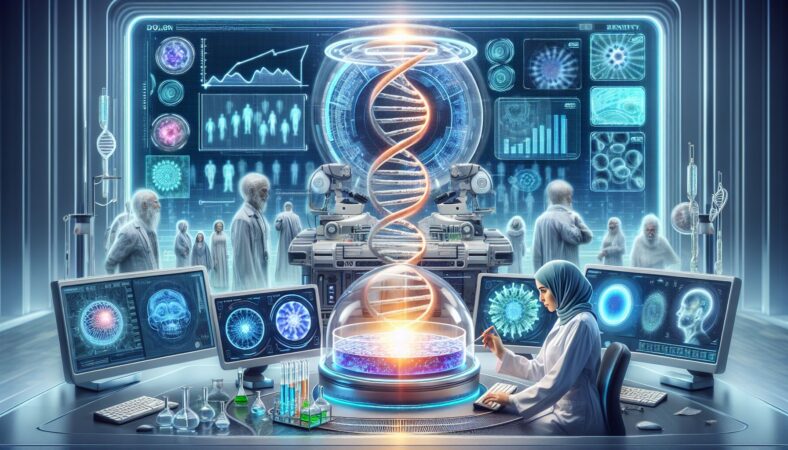
Ahoy there, fellow tech enthusiasts and wistful immortals! Today we are going to dip our toes into the limitless pool of regenerative science and explore the tech that promises to unlock the key to longevity. Because who among us hasn’t dreamed of having more time?
Now, I promise not to go fully “Philip K. Dick” on you (remember, he’s the genius who dreamt up “Do Androids Dream of Electric Sheep?” that eventually became the film, Blade Runner). But, as we explore this emerging area of tech, prepare yourself to face some startling, mind-bending, and honestly pretty wild facts. And maybe, just maybe, we’ll discover how close we are to reprogramming our biological clocks in the ambitious quest for longer, healthier lives.
The Current State of Longevity Innovation
We are living through some serious biomedical breakthroughs right now. Google’s Calico Labs, Unity Biotechnology, and the SENS Research Foundation are all working on innovative ways to fight aging. Yes, folks, Silicon Valley is throwing serious money at the quest for biological immortality.
Take Calico Labs, Google’s own longevity research company, for instance. They’ve partnered with biotech giant AbbVie and committed $2.5 billion to research and develop drugs that target age-related diseases like Alzheimer’s and cancer. That’s not pocket change.
Then you have Dr. Aubrey de Grey and the SENS Research Foundation. They’re conducting research into what Dr. de Grey calls “Strategies for Engineered Negligible Senescence”. The goal? Stop the aging process by repairing the damage it causes before it leads to deadly illnesses. Bold doesn’t even begin to cover it.
The Role of Genetics & CRISPR in the Longevity Quest
A huge chunk of longevity research focuses on cracking the codes buried in our DNA. Enter CRISPR, the genetic editing technology that’s changing everything. This tech lets scientists modify genes within organisms quickly and precisely. The possibilities are honestly staggering.
Ever heard of Elizabeth Parrish? She’s the CEO of BioViva, a company focused on gene therapy for cellular repair. Here’s the kicker: she became the first human being to undergo telomerase gene therapy as part of her quest to reverse aging. Are we playing God or just playing smart? I’m not sure anyone knows yet, and only time will tell us about the long-term effects of these treatments.
The Integration of AI in Unlocking Extended Lifespan
Artificial Intelligence is like having a superpower in the longevity game. It can spot patterns and connections that humans miss entirely. Insilico Medicine, a Baltimore-based startup, used AI to develop a compound that might slow down cellular aging. They used GANs (Generative Adversarial Networks) to create potential longevity drugs in just 46 days. And it passed animal trials successfully!
Even Elon Musk is in on this with Neuralink, his startup that wants to merge the human brain with AI. Talk about a wild mix of sci-fi and reality hitting us all at once.
The Ethical Question – Should We Strive for Longer Life?
While the thought of extending human life is pretty appealing (more time to binge-watch Netflix, right?), it does raise some serious ethical questions. There’s overpopulation to consider, the potential for massive economic inequality, and the fundamental question of whether we should mess with the natural order of life and death.
Yet, as a species, we’ve always sought to improve, grow, and push the boundaries of what’s possible. And if we’re honest with ourselves, isn’t the pursuit of a longer, healthier life just another expression of those basic human drives? I think it is, but I also think we need to be careful about how we get there.
Cool, But What’s Next?
So, are we on the brink of sipping from a fountain of perpetual youthfulness or is this all just far-fetched sci-fi nonsense? As I sit here typing on my aging 2021 MacBook Pro, I can’t help but feel that the reality lies somewhere in between.
But here’s what I know for sure: the progress we’re making in longevity tech is absolutely massive. It’s easy to see why. The possibility of added years of good health is incredibly tempting, both personally and as a business opportunity.
Sure, there will be hurdles, and there will be setbacks. Probably some spectacular failures too. But humans are a stubborn bunch. And if there’s one thing we excel at, it’s pushing boundaries until they break. So, stay tuned because the future of longevity is unfolding faster than most of us realize. I’m definitely along for this wild ride.