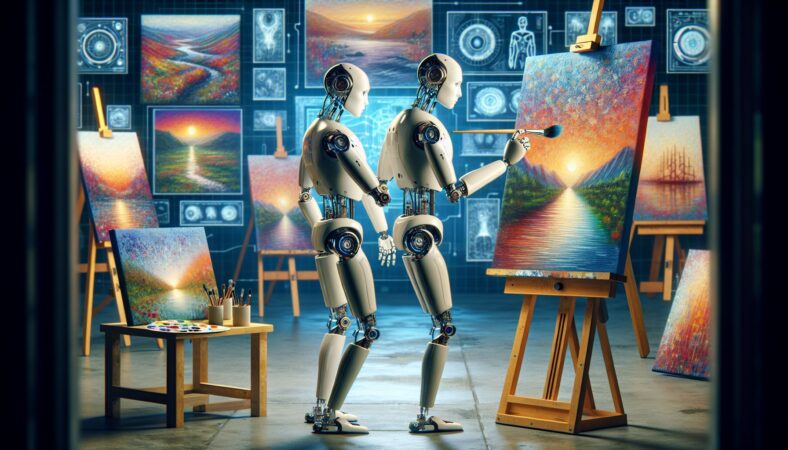
Good morning, fellow technophiles! Today, I want to share my thoughts on something that’s genuinely changing our world: how Artificial Intelligence and the arts are coming together. Now, before you roll your eyes, thinking, “Oh great, another post about robots doing human stuff,” let me assure you this isn’t your typical AI story. It’s something different, something exciting, dare I say, a new Renaissance.
THE UNEXPECTED ALLIANCE
The term ‘Artificial Intelligence’ usually brings to mind images of self-driving cars, predictive algorithms, and automated customer service. But over the last few years, innovators have been asking a fresh question: “What if we could teach AI to be expressive, to capture those subtle qualities that make us human?” We aren’t talking about replacing Picasso or Mozart here. We’re exploring how AI can contribute to the creative process.
It started with simple tasks: color correction in photography, background noise reduction in music, movie recommendations on Netflix. But, to quote Jeff Goldblum in Jurassic Park, “Life, uh, finds a way.” AI found a way into the creative arena. AI-generated music, AI-painted art, even AI-written stories!
Before we explore this brave, and sometimes strange new world, let’s have a bit of a history lesson.
AI IN ART: A BRIEF HISTORY
Ironically, the journey of AI in art began with chess (not what you’d call a traditionally ‘artistic’ pursuit). When IBM’s Deep Blue defeated world champion Garry Kasparov in 1997, it had a real impact. People realized AI wasn’t just about crunching data, it could strategize, it could ‘think.’ Shortly after, experiments began in weaving AI into various art forms.
In 2012, Google’s DeepDream started generating psychedelic images that look bizarrely similar to Salvador Dali’s paintings. In 2016, a team led by Mohammed Elgendi developed an AI that could analyze and understand a novel’s plot. More recently, OpenAI’s MuseNet can generate 4-minute musical compositions with 10 different instruments, spanning diverse styles.
THE FUTURE OF AI IN ART
So, what about the future? If current developments are any indication, AI will greatly expand our creative capabilities. But rest assured, creatives, your jobs are safe. AI isn’t about replacing artists but enhancing their potential.
AI’s contribution to creativity is about making the impossible possible. Imagine a filmmaker being able to generate custom scores on-the-spot during shooting to test different emotional impacts. Or a painter having an AI assistant that could suggest the best colors to capture the late afternoon sunlight.
CONCERNS AND CHALLENGES
Of course, no great revolution comes without its challenges and concerns. Art requires a deep understanding of human emotions. Can machines ever truly capture that? And what about authorship? If an artist uses an AI to generate a masterpiece, who’s the real creator?
There’s also a risk that AI could lead to boring, cookie-cutter art. If AI takes over parts of the creative process and artists start relying heavily on it, we might lose the individuality and surprises that make art worth experiencing.
WHAT DOES THIS MEAN TO US?
Change is the only constant, and this union of AI in the creative arts is simply part of our evolution. If the first Renaissance was about rediscovering the art and values of the ancients to fuel a cultural rebirth, this new Renaissance is about using technology to push creative boundaries. It’s about fluid collaboration between humans and machines, to express our emotions in innovative, thrilling ways.
So, hang on tight, my friends, as this continues to unfold. Our brave new world might have more than a few surprises in store!
Until next time, keep dreaming at the intersection of art and technology!