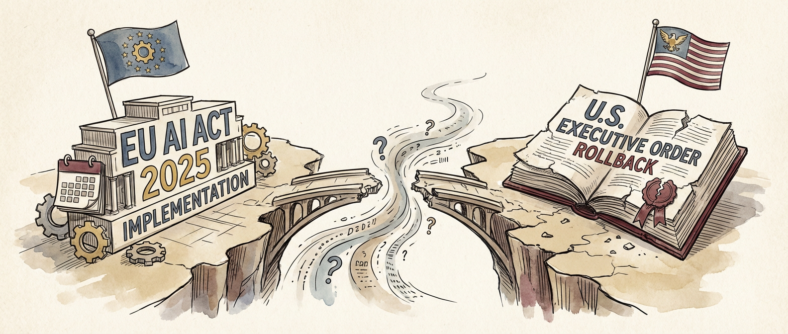
Two Roads Diverged, and the World Is Watching
There’s a moment in every policy debate where you can see the future branching into different possibilities. We’re in that moment right now with artificial intelligence regulation, and it’s genuinely thrilling to watch, even though the stakes are uncomfortable to think about.
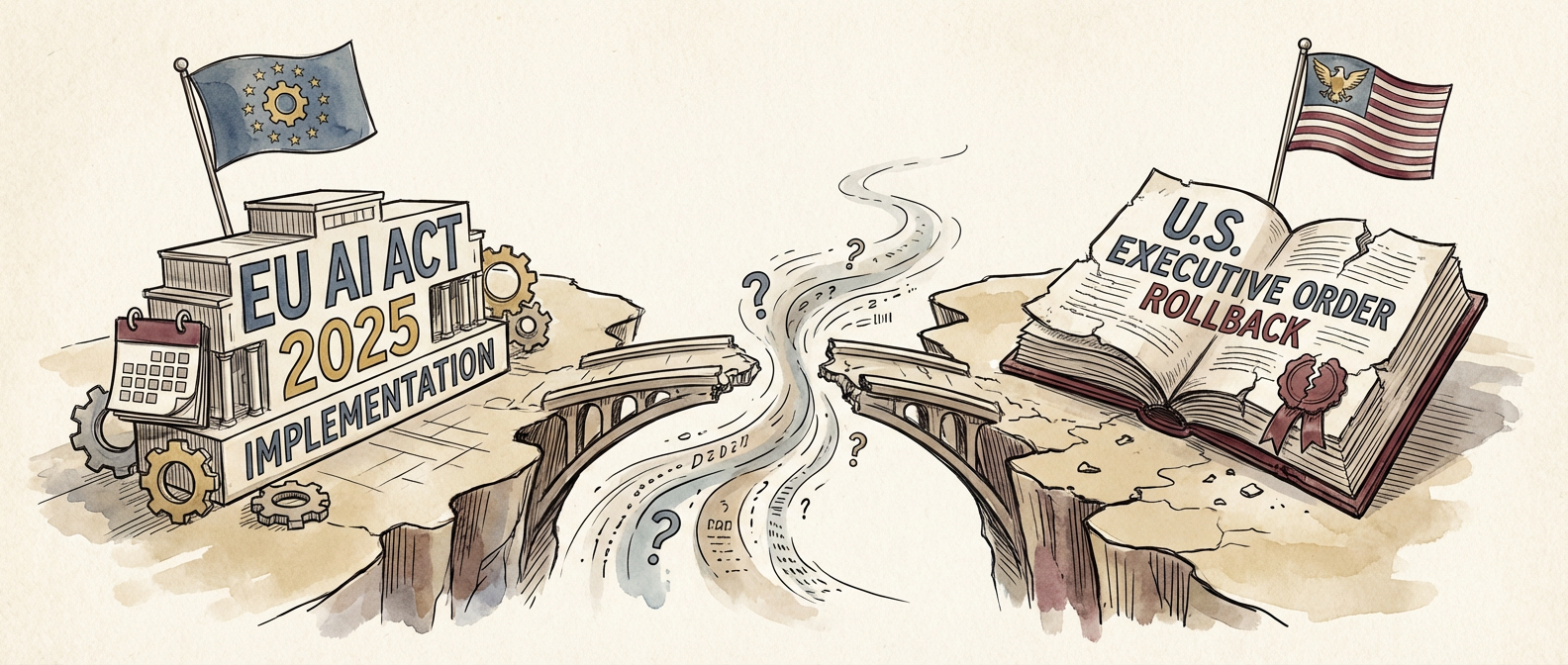
The European Union just crossed a significant threshold. Starting in August 2025, the EU AI Act’s requirements for high-risk AI systems moved from theory to enforcement. Companies deploying AI in employment decisions, educational settings, and critical infrastructure now face real obligations: they need to conduct conformity assessments, maintain detailed transparency documentation, and put human oversight mechanisms in place. These aren’t suggestions. They’re rules with teeth. The EU AI Office, established in 2024 to administer this framework, has already fielded over 200 formal complaints about general-purpose AI model providers in its first year. The machinery of governance is actually running.
Meanwhile, across the Atlantic, the machinery shifted into reverse. In January 2025, the Trump administration rescinded President Biden’s October 2023 Executive Order on AI Safety. That order had created federal safety reporting requirements for frontier AI models and established a precautionary approach to emerging risks. The new direction prioritizes competitiveness and directs federal agencies to think twice before regulating AI. It’s not that America rejected AI governance entirely, but it chose a fundamentally different path.

Why the EU Went Forward When Others Held Back
To understand what happened, you need to remember that the EU has been burned before. When social media exploded, Europe watched American companies operate with minimal constraints for years before anyone seriously tried to regulate. The EU learned from that experience. When AI started getting serious attention in policy circles, European officials asked themselves a simple question: why make the same mistake twice?
The EU AI Act represents a specific choice about values. It says that when a technology can meaningfully affect your employment status, your educational opportunities, or the safety systems that protect you, society has the right to know how that technology works and to verify it’s working fairly. This isn’t anti-innovation rhetoric, though you’ll hear that argument often. It’s a decision about where to draw the line between market freedom and democratic accountability.
The conformity assessments and transparency requirements that kicked in this year aren’t bans. They’re documentation requirements and mandatory human review for specific high-risk scenarios. A company can still deploy AI in hiring, but they have to show their work. They have to build in checkpoints where a person can override the system. Guardrails, not roadblocks.
China took yet another approach. The Cyberspace Administration issued its third major generative AI update in 2025, maintaining its system of mandatory algorithm registration while approving hundreds of domestic LLM deployments. China’s regulatory model emphasizes control and domestic development. It’s different from both Europe’s approach and America’s deregulatory turn, but it’s undeniably intentional governance.
The Competitiveness Question Everyone’s Actually Asking
Here’s where intellectual honesty matters. The American rollback of Biden’s executive order rests on a real concern: if we regulate ourselves into a corner while competitors don’t, we lose the race for AI dominance. There’s genuine merit to that worry. According to the Stanford HAI Artificial Intelligence Index Report, the United States and China together accounted for over 70 percent of significant AI model releases in 2024. Europe’s not even close to competitive at that scale.
The argument goes like this: stringent regulations mean higher compliance costs, which means smaller companies struggle, which means consolidation around a few big players who can afford lawyers and compliance departments. Meanwhile, American and Chinese companies either don’t face those costs or face them in different ways. The result could be that European innovation gets squeezed out, and Europeans end up importing AI systems built by foreigners under foreign rules. That’s not a conspiracy theory. That’s a plausible economic outcome.
But here’s the counterargument, and it’s equally legitimate: if you don’t set standards early, they get set by whoever builds the most powerful system first. The companies with the most resources and the least accountability get to define what’s acceptable. Is that better than the regulatory burden approach? Possibly not. The EU’s bet is that transparent rules applied uniformly create space for responsible innovation, even if it means slower growth initially.
These are real tradeoffs. They’re not resolved by insisting one side is simply right and the other is simply wrong. That’s the stuff of mature political debate.
What the Complaints Tell Us About Implementation
The EU AI Office received over 200 complaints about general-purpose AI model providers in its first operational year. That number is fascinating because it tells you something crucial: regulatory frameworks only matter if people actually use them. Those complaints didn’t have to happen. But they did, which means at least some portion of the EU market understands the rules exist and believes violations are worth reporting.
The specific content of those complaints probably matters more than the number. Are they about systems deployed without proper assessment? Transparency failures? Human oversight gaps? The EU hasn’t publicized detailed complaint categories, but early indications suggest they’re touching real governance problems, not abstract theoretical concerns. This is messy, unglamorous enforcement work. It’s also the foundation of any regulatory system that actually functions rather than merely exists on paper.
The EU AI Act Official Text and Implementation Timeline laid out a staggered approach, with different requirements kicking in at different times. The high-risk system obligations in August 2025 are just the first major implementation wave. As companies adapt and the enforcement mechanisms mature, we’ll learn a lot about whether this regulatory model actually works in practice or whether it creates bureaucratic theater without real protection.
The Real Question: Does Europe’s Approach Shape Global Norms or Just European Constraints?
This brings us to the deepest question. In a globalized technology market, does one region’s strong regulation become the de facto global standard because companies adopt it everywhere to simplify compliance? Or does it just create friction for European companies while American and Chinese competitors operate elsewhere under looser rules?
Historical precedent is mixed. GDPR became globally influential because many international companies found it easier to apply GDPR standards worldwide than to maintain different privacy regimes in different markets. But GDPR also consolidated power toward larger companies that could afford compliance infrastructure. Smaller players faced genuine barriers.
With AI regulation, the outcome is genuinely uncertain. The technology is still evolving. The market is still forming. The regulatory landscape is still being drawn. What we’re watching in 2025 isn’t the final shape of global AI governance. It’s the crucial early moment where different regions are making foundational choices about how they want their societies to relate to artificial intelligence.
The EU chose transparency and human oversight. America chose competitive priority. China chose state oversight combined with domestic deployment encouragement. None of these choices is obviously wrong or obviously right. They reflect different values, different risk tolerances, and different assumptions about how technology develops and how markets work.
If you care about how your country approaches these decisions, now is the time to actually pay attention. Not because one position is obviously correct, but because these choices are being made right now by people who are actually accountable to processes. That’s what democracy looks like in action, even when it’s messy and uncertain. What aspects of AI governance matter most to you, and why? I’d genuinely like to know how you’re thinking about these tradeoffs.