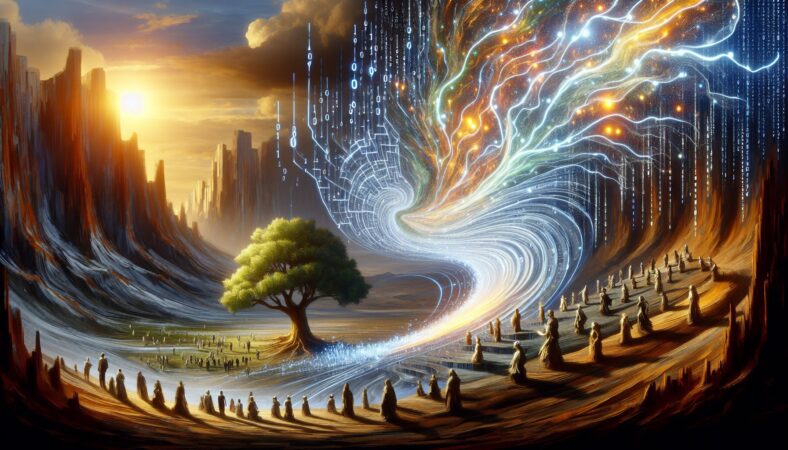
Hello there, fellow techno-optimists! I don’t know about you, but I am thrilled about the snowballing presence of artificial intelligence (AI) in our daily lives. It’s transforming almost every industry from health care and finance to transportation and entertainment, but let’s park those talks for another day. Today, I’m here to chat with you about an area where AI is making waves that you may not expect: the creative arts.
When Art Meets AI
You know the thrill when you stumble upon a new application for technology where you least expect it? That’s exactly how I felt the first time I saw an AI-generated artwork. It was a piece by an AI program called AICAN created under the supervision of Dr. Ahmed Elgammal. It went a step further from generating arts but even created a unique artistic style. An AI developing its own style. Just think about that for a moment. It’s like Van Gogh emerging from a computer program! Completely mind-blowing!
Learning from the Masters
What’s unique about AI in creating art is its learning process. Instead of a palette and a canvas, it has algorithms and databases. Neural networks based on deep learning models analyze countless images of classical art and contemporary pieces, studying the differences in style, color, shapes and patterns. It learns, or should I say, it trains itself to identify what makes a Rembrandt a Rembrandt or a Picasso a Picasso.
Back in the day, artists had to apprentice under masters for years to learn their style techniques. Now, AI can consume tens of thousands of images in a matter of seconds and create an artwork that resembles the mastery of these great artists. Surreal? I couldn’t agree more!
On Painterly Syntax and Generative Adversarial Networks
Let’s geek out with a bit of jargon, shall we? A major leap in AI creativity came with Generative Adversarial Networks (GANs), a class of AI algorithms used in unsupervised machine learning. GANs work under a clever system of checks and balances. They involve two neural networks competing in a zero-sum game format.
One network, the “generator,” creates the images while the other, the “discriminator,” judges them. The goal of the generator is to fool the discriminator into thinking the images it made are authentic, while the discriminator aims to improve at distinguishing real from fake. It’s a perpetual cat-and-mouse game, except here, both the cat and mouse are getting better at their tasks.
AI: The New Art Rockstar
Remember when I mentioned that AICAN piece earlier? Well, it took the art world by storm back in 2018 when it sold at Christie’s for a cool $432,500. It was supposed to sell for a mere $7,000 to $10,000. Talk about exceeding market expectations! This was a massive leap, with AI-generated art fetching big bucks at an esteemed auction house. It was like Warhol’s soup cans all over again. The establishment was rattled, the rules were rewritten, and a new player entered the arena.
But wait, there’s more! OpenAI, co-founded by our favorite tech maverick, Elon Musk, recently released MuseNet and DALL-E. These AI programs can create snippets of songs spanning a variety of genres and create artwork from textual descriptions, respectively.
Ethics in AI Created Arts
While we marvel at AI’s creative prowess, we need to pause and consider the ethical implications. With great power comes great responsibility, right? As AI creates more and better art, how do we navigate matters of copyright and creative ownership?
Not to be a downer, but we can’t deny that in this new creative world, artists who put blood, sweat, and tears into their work might struggle to compete. Protecting their rights and their livelihoods in a world where creativity can be coded is an emerging challenge we must address.
The Future of AI in Creative Arts
Okay, now that we’ve navigated the prickly ethical terrain, let’s continue our exhilarating ride into the future. We’ve seen AI compose music, paint pictures and even write movie scripts. (Side note: Remember when Benjamin, an AI with a sense of humor, wrote that bizarre screenplay, Sunspring? Ah, what a hoot!)
Looking ahead, we might see AI venturing into the more physical aspects of the arts. AI choreographers, anyone? Or virtual sculptors, perhaps? The possibilities are virtually endless.
I believe AI doesn’t diminish human creativity. Instead, it expands the canvas on which we can express our creativity. It gives a new axis for human creativity to revolve around. As I see it, AI is a new tool, not a replacement. A new palette of colors for us to use to paint our stories and tell our truths.
Wrapping it All Up
So, there you have it. The melding of AI and creative arts isn’t just about fancy algorithms or pricey auctioned art. It’s another remarkable display of our human ingenuity. It gives us a new lens through which to see, to appreciate, and to question our world.
The vinegar to our oil, the warp to our woof, or whatever metaphor tickles your techno-fancies. That’s AI in creative arts. It’s a thrilling intersection where the lines between technology and imagination blur and where we get to rewrite the rules.
Whatever happens in our AI-infused future, one thing is clear: it’s an exciting time to be alive. Until next time, my fellow futurists, let’s keep dreaming and keep creating! AI might just surprise us by joining us in our efforts. Raise your glasses to AI, the newest member of our creative jam!