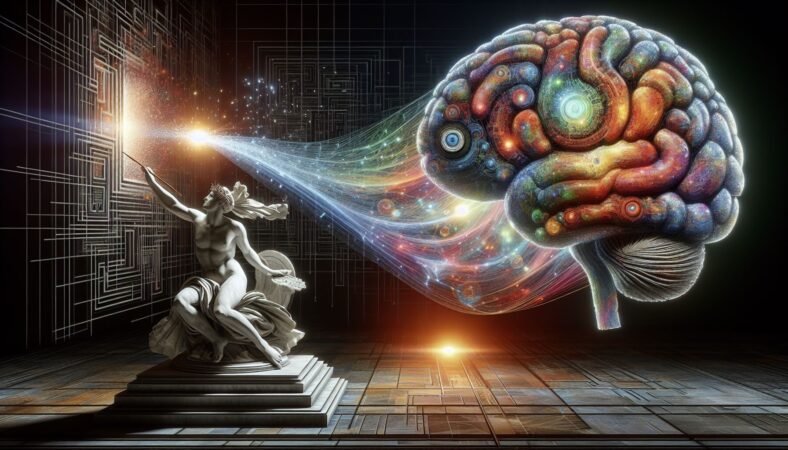
Hey there folks! If you’re like me, utterly infatuated with all things tech related and always looking out for the crossroads where technology and creativity meet, get ready. I’ve got a doozy for you today. We’re stepping into the eclectic world of artificial intelligence (AI) infiltrating the visual arts. And, hold on to your hats because this ain’t some dystopian nightmare straight out of a Hollywood Sci-Fi flick. It’s the beautiful marriage of machine learning and human creativity, and it’s nothing less than astounding. Join me, as we explore the colorful kaleidoscope that AI has brought into the world of art.
AI’s First Strokes on The Canvas
Let’s rewind a bit to the Picasso of AI’s artistic revolution, the one that set the stage for the computerized revolution in the world of art, the luminary that is Google’s DeepDream. Released in 2015, DeepDream was an experiment that showed how a neural network can be reverse engineered to create intriguing, dream-like images. It wasn’t perfect, and the surrealistic dog renderings it pumped out resembled more of a bad acid trip than bona fide art (to each, alien-dog-art loving own), but it hinted at the potential of AI in generating unique artistic content independently.
Fast forward to 2018 bursting onto the scene, we have “Portrait of Edmond de Belamy” by Obvious, an AI artist collective. This work of AI-art was auctioned off by Christie’s for an attention-grabbing sum of $432,500. Yes! You read that right. AI-created art was being bought for a price that could well buy a small island.
Getting Intimate with AI’s Creative Process
So, how exactly does computer-generated art work? The AI’s artistic process is no less fascinating than the result. The magic happens with something called a Generative Adversarial Network (GAN). In layman’s terms, a GAN pits two AI models against each other: the generator, which is trained to create seemingly random images and the discriminator, which is trained to discern between man-made and AI-generated art.
The two start their creative dance, squabbling and learning from each other. The generator keeps constructing images, the discriminator keeps judging them until one day the generator creates an image that the discriminator can’t recognize as AI-generated. And voila! AI-created art is born.
The Fine Art of Collaborating with AI
Now, purists might sniff at the idea that machine-generated art is indeed art. They argue that true art requires human heat, soul, and err, well, other passionately human stuff. To them, I say, welcome to the era of human-AI collaboration. Enter artists who see AI as a useful tool, a creative sidekick if you prefer, to augment their art. As Albert Einstein put it,”Even on the most solemn occasions, I got away without wearing socks.” Wait! Wrong quote. Here’s the right one: ”The true sign of intelligence is not knowledge but imagination.”
Take Mario Klingemann, who uses AI to play around with historic portraits and interviews, or Anna Ridler, who used AI to create a video installation from 10,000 tulips. These artists use AI not as a substitute but as an enhancer, using its capabilities to realize visions that might not be possible with mere human hands.
What’s Next on AI’s Artistic Journey?
Like everything else, AI’s evolution in the world of arts isn’t slowing down. Playform, an AI art studio, is working on creative tools that allow artists to collaborate with AI in more intuitive ways. Christie’s and Sotheby’s are regularly auctioning AI-created art, indicating a growing acceptance in the larger art community.
What comes next is anyone’s guess, but mine would be more collaboration. As AI continues to advance and improve, the potential for human-AI artistic collaboration is only going to grow. Artists mixed with AI, creating, inventing, and pushing boundaries. That’s a world I’m excited about.
Concluding Brush-strokes
In parting words, whether you perceive AI in art as Orwellian or an usher of a new creative era, one can’t deny the novelty it brings. AI in creative arts is a thrilling intersection that reminds us of the limitless potentials of technology. It forces us to question the depth of creativity, like “Can a machine truly be creative?” or “How many licks does it take to get to the center of a Tootsie Roll Pop?” Maybe that last one was a stretch, but you catch my drift.
And to respond to the skeptics, would I replace my favorite Da Vinci with an AI-generated portrait? Probably not (unless it’s like, really good). But would I be enthralled by the endless possibilities that AI brings into the realm of art? Heck yes!
AI’s entrance into the art world isn’t the end of human creativity. Rather, it’s the beginning of a new chapter in our endless journey to create and inspire. It’s our next step towards turning the technological utopia we’ve dreamt about into a reality. So here’s a toast to the moment where AI and creativity collide, and give birth to a whole new panorama of artistry! Can’t wait to see what’s painted next.