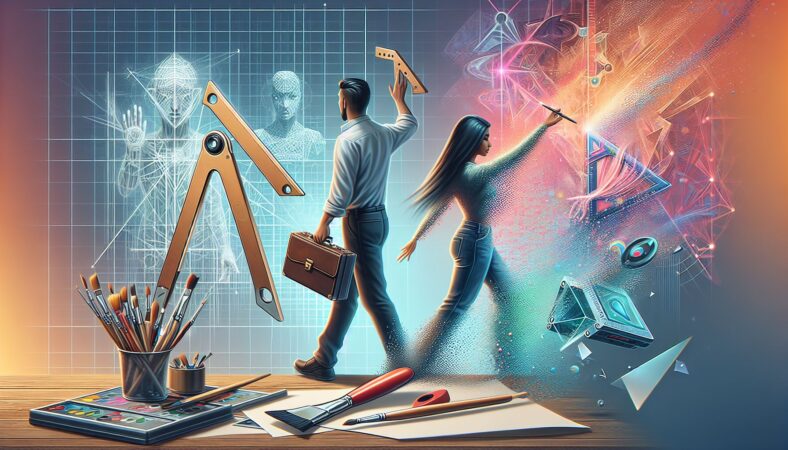
Have you seen the AI art marveling the world recently? No more tussling with T-squares or fussing over proportions – artificial intelligence has begun revolutionizing creative arts recently and, trust me, it’s pretty awesome!
As someone who was knee-deep in traditional art supplies as a kid (I’m never going to get over the nostalgia of pastel dust smeared all over my fingers), the rapid rise of AI in the creative arts feels like an exhilarating leap into the future. It’s opening doors I never thought possible.
When AI Becomes The Artist
Now, it’s no secret that AI is transforming the art domain. While computers and digital technology have captured the creative world for some time, AI takes this to a much bigger level. It’s not just copying anymore, it’s actually creating. Who would’ve thought our humble PCs could one day turn into Picasso?
Remember that portrait “Edmond de Belamy” that an artificial intelligence system sold for a mind-blowing $432,500 at Christie’s? Or when OpenAI’s MuseNet stunned the music world producing harmonic tunes no human could concoct? Pretty remarkable, right?
As an art enthusiast, this is an electrifying time. We’re witnessing art creativity in a new dimension, and I personally find it fascinating how AI merges logic with intuition, procedure with randomness, and patterns with creativity. It’s like watching a new kind of brain at work: The AI artist.
AI In Legacy and Promise: Architecture Redefined
Aside from painting and music, another creative industry where AI is planting its foot firmly is architecture. It’s like Frank Gehry and Rem Koolhaas have morphed into super-architects with near super-power abilities, thanks to these new AI developments.
Generative design, a process that uses AI algorithms to create countless design solutions based on pre-set parameters, is bringing a new architectural revolution. It’s exhilarating to imagine AI exploring billions of possibilities in a fraction of the time it would take human designers.
For instance, the AI tool “Dreamcatcher” engineered by Autodesk, helps architects design energy-efficient buildings, perfectly adapting to climate, materials, and usage patterns. As someone who loves a sustainable lifestyle, the prospect of AI perfectly balancing aesthetic, utility, and climate-friendly architecture feels like the dawn of something special.
The Dialectics: Are We Ready To Embrace AI Artists?
As much as the incursion of AI into the creative arts is exciting, it’s also been raising some eyebrows. Intriguing questions about copyright, originality, and the essence of creativity are surfacing in this new AI-art-world order.
Is an artwork still original if an algorithm spit it out? Does AI actually create, or just mimic well-taught patterns? Even though I’m an AI-optimist at heart, I notice these dilemmas through my rose-colored glasses, and I think they’re important to grapple with.
Honestly, as AI continues to blur the line between human and machine creativity, these questions add a philosophical layer to our techno-advances. They challenge us to think not just about “how far can we go” technologically, but “how far should we go” ethically and aesthetically.
Seizing the AI Wave: What’s Next?
In the long run, as we immerse ourselves into the world of AI creativity, the possibilities seem limitless. The fusion of human and machine intelligence can spawn unimaginable creative outcomes, going beyond traditional artistic boundaries.
Let’s think of AI as a tool, a set of brushes in our artistic palette. Some it uses on its own, while others work in our hands. By carefully navigating the challenges, I believe we can harness the power of AI to truly elevate our creative abilities. Like catching a wave and riding it, instead of being swept away.
As we stand at the edge of this shift in the creative arts field, we’re definitely peering into a thrilling tomorrow. The metamorphosis from T-squares to AI paintbrushes is staggering, and I can’t wait for what unfolds next in this tech-creative drama.
All aboard, artists and onlookers! The AI show has already begun!