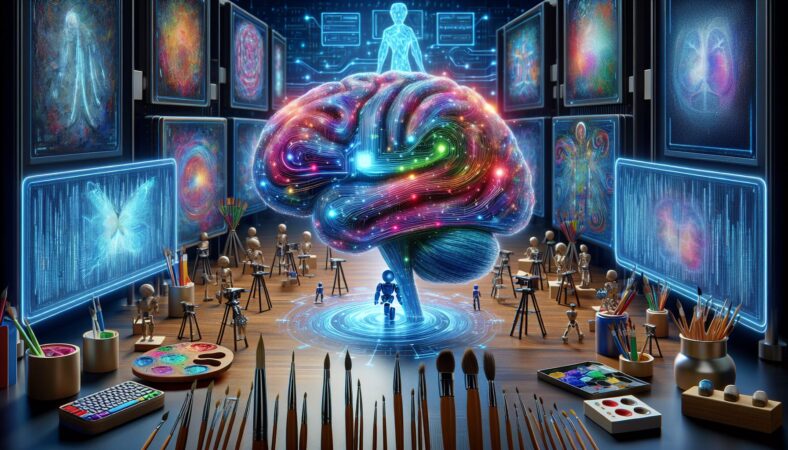
Friends, gather ’round, because I assure you, we’re not in Kansas anymore. No disrespect to Kansas, but the creative world has changed so much lately that it feels like we’ve tumbled down the rabbit hole. And at the center of it all? You’ve guessed it. Our old friend AI. Buckle up, because we’re about to dive into how artificial intelligence is changing the creative arts.
Off to the Races: AI’s Entry into the Creative Arena
It all started as a hobby project for some brilliant folks at Google with their DeepDream. Remember that? Suddenly everyone could turn into Van Gogh, with each uploaded photo becoming a swirling, dreamy landscape that was part reality, part psychedelic trip.
But wow, how far we’ve come since then! Now we’re living in a world where AI-generated art sells for nearly half a million dollars at Christie’s. Crazy? Maybe. Fascinating? Absolutely!
I’m a bit of a traditionalist when it comes to art. Give me a good old Salvador Dalí or Pablo Picasso any day. But I have to admit, AI’s entrance into the creative world has me curious.
Let’s be honest, most of us (myself included) were skeptical about AI creating art at first. “Art needs real human emotion and instinct! AI can never copy that!” was the common reaction. Creativity felt uniquely human, something unquantifiable that can’t be programmed into robots and algorithms.
My doubts started shifting after seeing the works by AICAN, the AI artist developed by Rutgers University’s Art and Artificial Intelligence Lab. The system, trained on over 80,000 pieces of art, began producing compelling pieces that made me question what creativity really means and whether AI can actually move people emotionally.
Da Vinci Code: How Does AI even Create Art?
Alright, it’s easy to get caught up in AI’s artistic achievements. But let’s stop for a moment and think about the ‘how.’ How is AI even doing this?
AI art happens through something called a Generative Adversarial Network, or GAN for short. Basically, a GAN has two parts: an artist and a critic. The artist creates the art, and the critic judges the work based on what it knows about art.
Picture Picasso and Da Vinci in a room with Da Vinci painting and Picasso offering critiques until they both agreed on a masterpiece. Sounds wild, right? But that’s pretty close to how GANs work! Endless trial and error, constant improvement, and eventually, you get a work of art.
The Creative Future With Artistic AI
Even with all the doubters, I think AI isn’t trying to replace human creativity. Instead, it’s here to enhance it. Like a high-tech paintbrush, it’s just another tool for artists to use and explore new creative territory.
Take OpenAI’s MuseNet, for example. It’s an AI project that can write entire songs, from Mozart-style classical pieces to modern pop songs. When human artists use tools like this, we might see completely new combinations of styles and creative possibilities we never imagined.
Wrapping Up
At the core of this conversation is a big question about creativity: is it something only humans can do, or can AI contribute in its own way? Maybe AI will never truly understand the emotion behind the yellow in Van Gogh’s “Sunflowers” or grasp Picasso’s passion in “Guernica.”
But AI’s effect on the art world can’t be ignored. These algorithmic artists are here to stay, and honestly, I’m excited to see how they’ll continue mixing with human creativity to change what art can be.
As always, art is in the eye of the beholder, whether that eye belongs to a human or a computer trained on thousands of paintings. For now, I’m ready to grab a cup of coffee, sit back, and watch this AI Renaissance happen. So stick around, my friends, because our technological trip down the rabbit hole is just getting started!