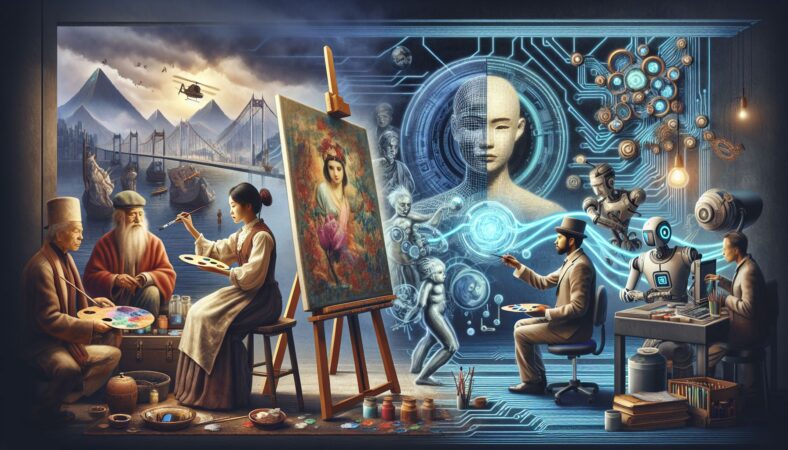
Alright, fellow trend-watchers! Roll up your sleeves, dial up your curiosity levels, and adjust your lens to focus on a fascinating corner of the tech world that feels like it’s leaping straight out of sci-fi novels and onto today’s canvas: AI in the creative arts.
Smart Paintbrushes and Beyond: AI Gearing Up for a Stroke of Genius
A lot is happening in AI-land. Heck, I even heard rumors of a sentient toaster last week that engaged its owner in a philosophical discussion on the existence of good and evil (Kidding! Those rumors may not always contain factual content). Yet, talk about AI and most of the attention goes to funny chatbots, self-driving cars, or machines that beat champion players at their game. But there’s another slice of the AI pie that’s turning heads: AI in the creative arts.
Remember that AI-generated portrait, “Edmond de Belamy”, which sold for a whopping $432,500 at Christie’s? Or OpenAI’s MuseNet creating an amazing rendition of Bohemian Rhapsody? By using algorithms and neural networks, artists and techies are exploring uncharted creative territory, bringing together AI’s innovative power and the authentic spark of human art.
When Algorithms Meet Aesthetics: The Basics of AI Art Creation
The basics of AI in creative arts mostly revolve around machine-learning algorithms. Here’s the thumbnail sketch of how it works. AI, through a process called ‘deep learning’, gets trained on thousands of art pieces ranging from traditional art to modern day creations. Each art piece gets broken down into tiny details: the lights, the darks, the textures, the brush strokes, everything that makes up an artwork. The AI absorbs it all, learns the essence of creativity (how daunting is that?), and then, copying these learned traits, it creates its own unique piece of art.
Deep Art Effects, DeepArt.io, Prisma—these AI apps let users turn their photos into art by using filters inspired by famous artworks. And we’re not talking about just simple copying; we’re talking about real transformation. Music videos, movie scenes, TV ads get reimagined while keeping the style and essence of great artists like Picasso, Van Gogh, and Monet. Soon enough, your Instagram feed might become a virtual Louvre!
AI Artists: Infinite Potential or Creativity on a Leash?
As with any tech breakthrough, there’s a bit of a debate brewing about AI’s potential in this arena. There’s a divide between those who see AI’s entry into the arts as an exciting new tool in the creative process and those who believe it threatens the sanctity of human creativity.
In the AI art camp, folks view AI as a new medium, similar to how we use paintbrushes or digital design software. They argue that art is about ideas and expression, and if a machine can help with that pursuit, why not embrace it? It’s like inviting a new guest to the creative party. I mean, who’s saying no to an extra sidekick, right?
On the flip side, there are those who are highly skeptical. Artists who view AI as a threat to human creativity, fearing the prospect of human imaginations losing their hold over the creative arts. In their view, AI might take the magic out of art, turning it into a calculated, predictive product, empty of the raw, untouched essence that only a human heart can bring.
To be fair, both viewpoints have merit. Yet, we can’t ignore that the mixing of technology and creativity has always shaped the way we generate and perceive art. Photography, digital art, VR art—aren’t these all examples of technology pushing the boundaries of artistic expression?
Weaving Dreams with Pixels: The Future of AI in Creative Arts
The potential for AI in the creative arts is enormous, and we’re only at the tip of the iceberg. Imagine an AI composing a symphony inspired by Beethoven or creating a virtual reality installation that explores complex human emotions. Powerful machine learning could add diversity and depth to the creative process, opening up limitless possibilities, with plenty of controversy stirring the mix.
I believe it’s not a question of AI taking over human artists, it’s about the collaboration of the two. If AI can help artists push their creative boundaries, then it’s something to celebrate. Will it create challenges? Of course, it will. It’s a wild new world out there. But hey, wasn’t every great leap in technology a bit of a wild ride?
In the end, AI in the creative arts is just another dimension of human imagination exploring new depths. Mixing algorithms and aesthetics might seem like a radical pursuit, but isn’t that what creativity is all about? Challenging conventions and venturing into the unknown? As for me, I’m pouring a big bucket of popcorn and settling in to enjoy this beautiful art-tech relationship.
Until next time, keep exploring, keep innovating, and of course, keep adding puns to your tech talks. Because, why not.