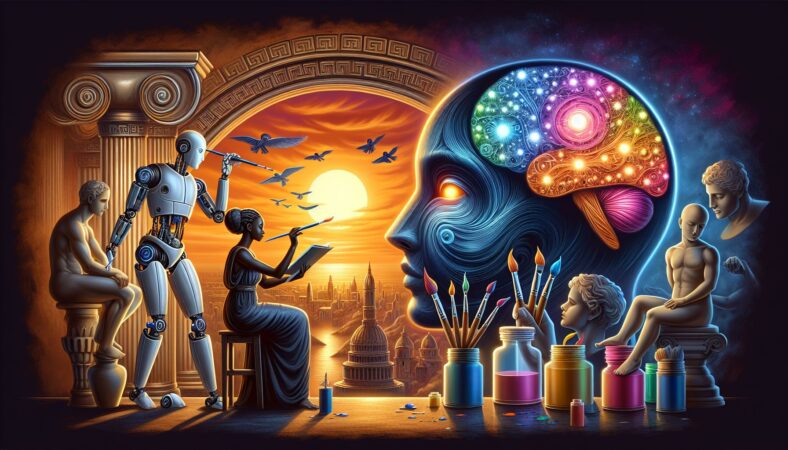
In our hyper-connected, tech-saturated world, nothing stays the same for long, especially the arts. Art and technology are colliding in ways that are creating entirely new forms of expression, and artificial intelligence is driving most of this change.
The Progress of AI in Art
It started with basic sketch suggestions and simple automated drawings, but now AI is seriously trying to become the next Picasso. Generative Adversarial Networks (GANs) have gotten so good at creating sophisticated portraits that you can’t always tell if a human or machine made them. You probably heard about that AI-generated piece that sold for $432,500 at Christie’s auction house.
The combination of art and AI goes way beyond making pretty pictures. We’re watching AI completely change how creative work gets done, birth entirely new art forms, and force us to rethink what creativity even means.
DeepArt, DeepDream, DALL·E: The Vanguard of AI in Art
Tools like DeepArt and DeepDream let anyone transform their photos into art that mimics famous painters’ styles. The results can be weird, surreal, and surprisingly beautiful. It’s proof that creativity isn’t some humans-only club anymore.
Then OpenAI dropped DALL·E, an AI that creates images from text descriptions, and everything changed. This wasn’t just copying existing art anymore. AI was making original, compelling pieces that dive into abstract and surreal territory that even human artists struggle with.
The AI Artist – Unleashing Boundless Creativity
Here’s where things get heated: can AI actually be creative? Critics say no way. AI doesn’t have human emotions, life experiences, or that gut instinct that real artists rely on.
But honestly? AI has shown some pretty convincing creativity. It’s not just copying old artworks or mimicking styles. It’s generating new patterns, themes, and visual stories that feel genuinely original.
That said, I don’t think AI will replace human artists. Think of it more like another brush in the toolkit. Artists can use AI to create stuff that would have been impossible to imagine just twenty years ago.
The Future of Art in the Age of AI
Here’s where things get messy: copyright and ownership. If an AI creates artwork, who actually owns it? The AI itself? The programmer who built it? The person who typed in the prompt? Our legal system isn’t ready for these questions, but we’re going to have to figure it out fast.
Even with these complicated issues, I’m optimistic about where this is headed. AI is opening up incredible opportunities for artists and giving them entirely new ways to express their creativity.
Plus, AI is making art accessible to everyone. You don’t need a fine arts degree or expensive supplies anymore. As these tools get easier to use, we might be looking at a future where anyone can be an artist, where everyone has a way to express their creativity.
Conclusion
Artificial Intelligence is definitely changing art. It’s pushing creativity into new territory, creating art forms we’ve never seen before, and making art creation accessible to everyone. AI is painting itself into the art world, and we’re watching a new artistic revolution unfold. Sure, there are challenges to work through, but the potential here is incredible.
The question isn’t whether machines can make art anymore. It’s how AI will redefine what art means in our digital age and change how we think about creativity itself. The combination of art and artificial intelligence opens up possibilities that will reshape not just the art world, but how we understand creativity and expression. We’re waking up to a world where art comes from both human minds and the artificial intelligence we’ve created.