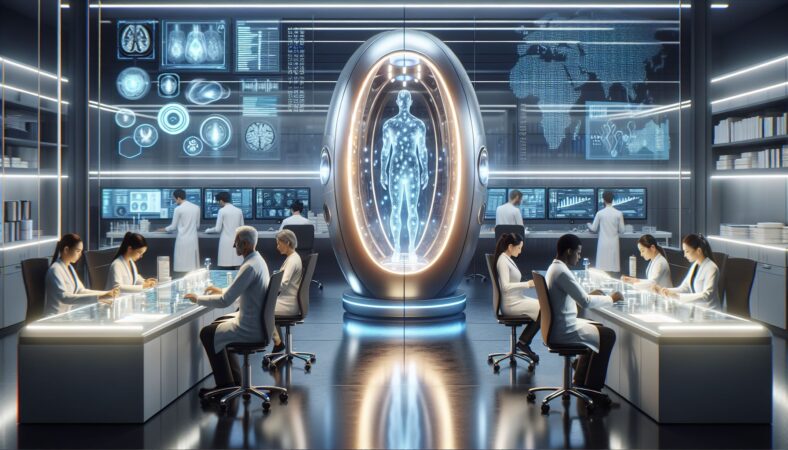
Hello fellow techies! Today, I’m excited to dive into a topic that’s not just close to my heart but will quite literally extend all our hearts’ lifespans (and anything else for that matter). Let’s talk longevity tech—where science meets technology to extend human lifespans and enhance quality of life. It’s some sci-fi level stuff, and I love it.
Rise of the Methuselahs: Lessons from the Cyberdelic Frontier
Just when you’re starting to get comfortable with self-driving cars and AI-developed art, the tech world throws another curveball. “Immortality,” they say. “Just a few decades away,” they claim. It does sound like something straight out of a sweeping epic Ridley Scott film. But hold onto your virtual reality headsets, because this isn’t a sci-fi trope. Longevity tech is shockingly real.
The concept may sound new, but it’s been brewing in the minds of innovative thinkers for a while. The idea of humans shattering the traditional barriers of age has always fascinated me. My first brush with this transhumanist notion was reading Ray Kurzweil’s “The Singularity is Near”. I mean, who could forget Kurzweil’s bold proclamations about machines morphing consciousness into indestructible machines by 2045?
His visions seemed outlandishly audacious back then, but now we’re on the edge of an era where genes can be edited, biological aging can be slowed, and our molecular integrity can be maintained for unthinkable stretches of time.
The Alchemists of the Tech World: Unraveling the Secrets of the Human Body
Are we ready to become a generation of Methuselahs, armed with the medical means to live for centuries?
Well, not so fast, friend. But the wheels are definitely in motion.
It starts with understanding the human body in ways we never have before. Pioneers like Google’s Calico Labs and Human Longevity Inc., and biotech firms like Unity Biotechnology are leading the charge. They’re diving into the molecular world, decoding the secrets of genes, cells, and all the internal clockworks that make us tick.
Take the approach of gene editing, for example. CRISPR technology hints at a world where gene-related ailments are vanquished, and our biological clocks can be reset. But it’s not all about editing out the bad stuff. It’s also about reinforcing our bodies with new genetic reinforcements—sort of like slipping some state-of-the-art armor under our biological skin.
Living Forever: Utopia or Dystopia?
But let’s take a breather and ponder the ethical mess tech longevity stirs up. What happens when we elongate our life spans? Will it lead to an overpopulated planet or will the dynamics of society shift to compensate for this new reality? And who gets to live long? The rich, the influential, the worthy? How would we even define who’s worthy?
It’s not hard to see how this could spiral into a heated “Black Mirror” episode.
But fret not. We have minds like David Sinclair who advocates that the objective of longevity tech should not be to make rich people live longer, but to make all individuals healthy for longer. Phew, thank God for that!
The Vertigo of the Future
Even with all these challenges, the potential for longevity tech is staggering, and it’s clear it’s here to stay.
To me, the field is much like an untamed electronic beast, humming, sparking, stretching towards the heavens in ways that are equally mesmerizing and confounding. Every breakthrough brings us closer to what was once the realm of gods—a reprieve from the inevitability of death.
As we continue unraveling the mysteries of our bodies and the universe around us, longevity tech drives home the fact that we truly are living in an era where anything seems possible.
I can’t help but feel jittery with excitement every time I think about it, yet the thought is always tinged with a sense of vertigo. It’s like peering into a future so radically different from our present that it sends our mind spinning. But isn’t that the best part about being neck-deep in this insane sandbox of emerging tech?
In the end, we may not become immortal within my lifetime, but if we can promise our children a world free of age-related sickness and weakness—or simply a few more quality years to share with their loved ones—isn’t techno-utopianism ultimately worth pursuing?
Call me a hopeless optimist, but I haven’t quite given up on the ideas put forth in those dog-eared pages of Kurzweil’s book.
So let’s dive headfirst into this brave new world together. After all, if today’s world of skyrocketing Dogecoins and AI-generated pop music has proven anything, it’s that the future is always far weirder than even the most offbeat, tech-obsessed, future-gazing blogger could predict. And I, for one, love every thrilling, terrifying, techno-utopian second of it.