Hello folks,
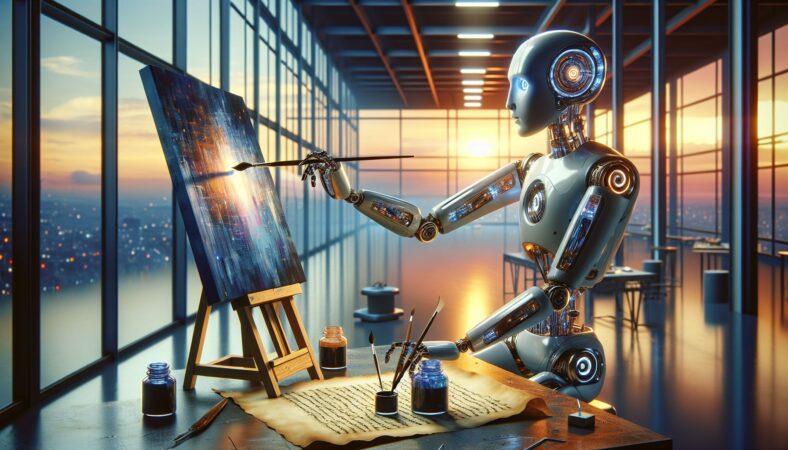
Imagine yourself at an art exhibition. You’re sipping some fancy red wine, discussing a unique painting gripping your attention. You glance at the nameplate expecting to see the artist’s name and get an odd surprise: the creator of this masterpiece is not a person but an artificial intelligence (AI). Welcome to the weird new world of AI in creative arts.
As a die-hard tech enthusiast with an unexpected weak spot for the arts, yes, I’m that weirdo who carries both a Raspberry Pi and a poetry book in their backpack, I’ve been watching this trend closely. Today, I thought I’d share some of my observations and thoughts with you.
Making Art: A Human Domain?
Art, our fascinating expressions of emotion, story-telling, and perceptions, has historically always been seen as a distinctly human domain. It reflects our unique consciousness, our personal histories and soulful emotions. So, the idea of a heartless machine creating art seems a bit like blasphemy. I get it. But before we form our technophobic mob, let’s dig a little deeper.
AI Artists: A New Wave
A few years ago, a painting created by an AI algorithm (aptly named Portrait of Edmond de Belamy) sold for a whopping $432,000 at Christie’s auction house. The artwork wasn’t the random scribbling of a binary toddler. It was a sophisticated, compelling piece that had fooled quite a few connoisseurs. This was the first real signal of a revolution quietly brewing in AI labs worldwide.
AI has evolved from executing mundane, automatable tasks to mimicking artistic creativity, arguably one of the most complex human capabilities. But how is this even possible? AI has reached this level thanks to improvements in Neural Networks and Generative Adversarial Networks (GANs). In simple terms, machines now learn from a database of works and then use this knowledge to create something original, basically copying how humans learn.
The AI-Muse: Tech Companies On Board
Tech giants like Google and IBM, along with numerous start-ups, are leading this fascinating revolution. For instance, Google’s Magenta project focuses on using machine learning to generate music and visual art. It’s like having Bob Ross, Van Gogh and Mozart rolled into a stack of code and algorithms.
IBM, meanwhile, took a more Douglas Adams approach with their Watson Beat. This AI composes music based on any specified mood or style, giving musicians (or just a regular old Joe with a guitar) access to an interstellar, hyper-intelligent muse.
The Automation Quandary
While AI in the arts is exciting, it casts a shadow over human artists. Could they be out of work because of it? The answer, as is often the case with emerging technologies, is complicated.
On the optimist’s corner of the ring, tech evangelists like myself argue that AI will drive art into a dimension of unimagined innovation. It’s a tool, and like all tools, it’s all about how we use it.
On the doomsayers’ side, there’s the fear of redundancy and the dilution of human creativity.
Only time and trials will tell how this transformation plays out.
A Step Towards The Singularity
AI venturing into the creative territory raises interesting possibilities about the future of machines. Even folks like Elon Musk and Sam Altman at OpenAI admit that AI’s venture into creativity is a big step towards the singularity, the theoretical point where AI will surpass human intelligence.
It’s an intoxicatingly thrilling, albeit kind of terrifying vision of the future (pull out your popcorn for the real-life sci-fi). And while the discussion of singularity would require its whole series of blog posts, and perhaps a couple of stiff drinks, it is undeniably tied to AI’s journey into the arts.
Conclusion
AI’s entry into creative arts is more than just a flashy tech trend. It’s challenging our traditional ideas about creativity and raising interesting questions about whether machines can mimic, or perhaps even surpass, human emotional intelligence. Whether this is cause for celebration or concern largely depends on your perspective.
I’ll wrap up by saying that regardless of your stance on the matter, the intersection of arts and AI is an exciting place to be right now. It’s like standing on the edge of a brave new world, unsure of what’s out there, but thrilled about what we might discover.
But remember, folks, as we keep daydreaming about a future dominated by AI in the arts, let’s not forget to value the human element. Even amidst all the 1s and 0s, there’s something irreplaceable about the human touch in art.
Don’t believe me? Ask an AI to truly appreciate a sunset. At least for now, our computational companions will fail that test. And that’s somewhat comforting, isn’t it?