Author: Herman Knight

Sovereign Wealth Funds, Explained: What Trump’s 2025 Executive Order Actually Means

Why Everyone’s Suddenly Talking About Norway’s Money Jar

In February 2025, President Trump signed an executive order tasking the Treasury Department and Commerce Department with developing a concrete plan for something the United States has never had: a federal sovereign wealth fund. You have ninety days, it essentially said. Make it happen. If you’ve been scrolling past headlines about this and wondering what the fuss is about, you’re not alone. Most Americans don’t think about sovereign wealth funds the way they think about Social Security or infrastructure spending. But this policy question sits right at the intersection of fiscal strategy, constitutional authority, and how we as a nation decide to invest in our future. That’s worth understanding.

Here’s the straightforward part: a sovereign wealth fund is a pool of money that a government sets aside and invests on behalf of its citizens. Norway’s fund, the most famous example on the planet, holds over $1.7 trillion in assets. It’s built from decades of oil revenues. The fund generates returns through global stock and bond investments, and those returns help fund Norway’s government services and support future generations. It’s basically a national savings account that works like a pension fund. The United States, by contrast, is one of the only major economies without a federal sovereign wealth fund. That’s a genuine policy gap worth examining.

What Would America’s Version Actually Look Like?

The executive order doesn’t specify the details, which is precisely why the ninety-day deadline matters. Treasury Secretary Scott Bessent has indicated that the fund could potentially be seeded using revenues from tariffs, the monetization of federal assets, or a combination of both. That matters because it tells you something about the philosophy: this wouldn’t be a completely new government expenditure. It would redirect existing or anticipated revenue streams into a long-term investment vehicle. The question becomes what counts as a legitimate revenue source and how transparent the process would be.

Alaska offers the closest American precedent. The Alaska Permanent Fund was established in 1976 and is fed by oil revenues. It distributes annual dividends to residents and has also invested for long-term growth. In 2024, each Alaska resident received a dividend check of $1,702. That’s not transformational wealth, but it’s real money that comes from the state’s resource revenues being managed strategically rather than spent entirely in the current budget cycle. If you wanted to understand what a working U.S. sovereign wealth fund might actually do for people’s lives, that’s a concrete example to study.

The Evidence Skeptics Are Raising

Here’s where the intellectual honesty kicks in. The Peterson Foundation analysis of sovereign wealth fund proposal released in March 2025 raised legitimate concerns that deserve serious consideration. The primary worry: a politically directed sovereign wealth fund could crowd out private investment and create structural conflicts of interest. When government becomes the biggest investor in certain sectors, it changes the competitive dynamics in ways that might not benefit the broader economy. Private capital gets less attractive relative to government-backed capital, even if the private option might generate better returns.

There’s also the governance question. Who decides how the fund invests? What prevents the administration in power from directing investments toward politically favored industries or regions? Norway’s fund has independent governance structures and investment criteria that insulate it from short-term political pressure. Building those structures from scratch in the American political environment, where every major institution faces partisan scrutiny, is genuinely hard. Not impossible, but it requires more than good intentions. It requires institutional design that survives changes in administration.

The Constitutional and Practical Barriers

Before you even get to the policy merits, there are foundational questions about authority and funding. Congress controls the federal budget and appropriations. An executive order can direct agencies to develop a plan, but actually creating and capitalizing a sovereign wealth fund likely requires congressional action. That’s not a trivial obstacle in a divided government. Where exactly does the initial capital come from? If it’s tariff revenues, that money was presumably expected to be spent or used to reduce the deficit. Redirecting it means other priorities don’t get funded. If it’s from monetizing federal assets, which assets and at what price? These choices have real winners and losers.

The White House executive order on U.S. sovereign wealth fund is the official starting document, and it’s worth reading yourself rather than relying on summaries. It establishes the timeline and the agencies responsible, but it doesn’t resolve these structural questions. That’s what the ninety-day planning period should address, assuming it’s conducted with genuine rigor.

What You Should Actually Do With This Information

The real value in understanding this issue isn’t about deciding whether sovereign wealth funds are good or bad in some abstract sense. It’s about knowing which questions to ask when any administration proposes something like this. How would it be governed? Who decides investment strategy? What transparency mechanisms exist? How does it interact with existing federal revenue and spending? What happens when administrations change? These aren’t partisan questions. They’re structural questions that apply regardless of who’s in charge.

If you’re genuinely interested in how this develops, bookmark these agencies: the Treasury Department and the Commerce Department will be issuing their recommendations. Read them when they come out. Look for independent analysis from the Peterson Foundation, the Congressional Budget Office, and major think tanks across the political spectrum. Notice which concerns come from the left, which from the right, and which are universal. That’s how you move beyond headlines into actual understanding of what’s being proposed and what the trade-offs really are. Democracy works better when citizens engage with policy at that level of specificity.
Trump’s Second-Term Tariff Gamble: What 2025’s Trade War Actually Cost Us

The April Announcement That Changed Everything

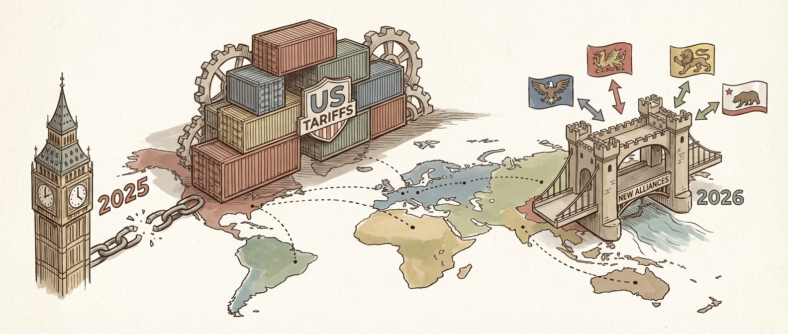
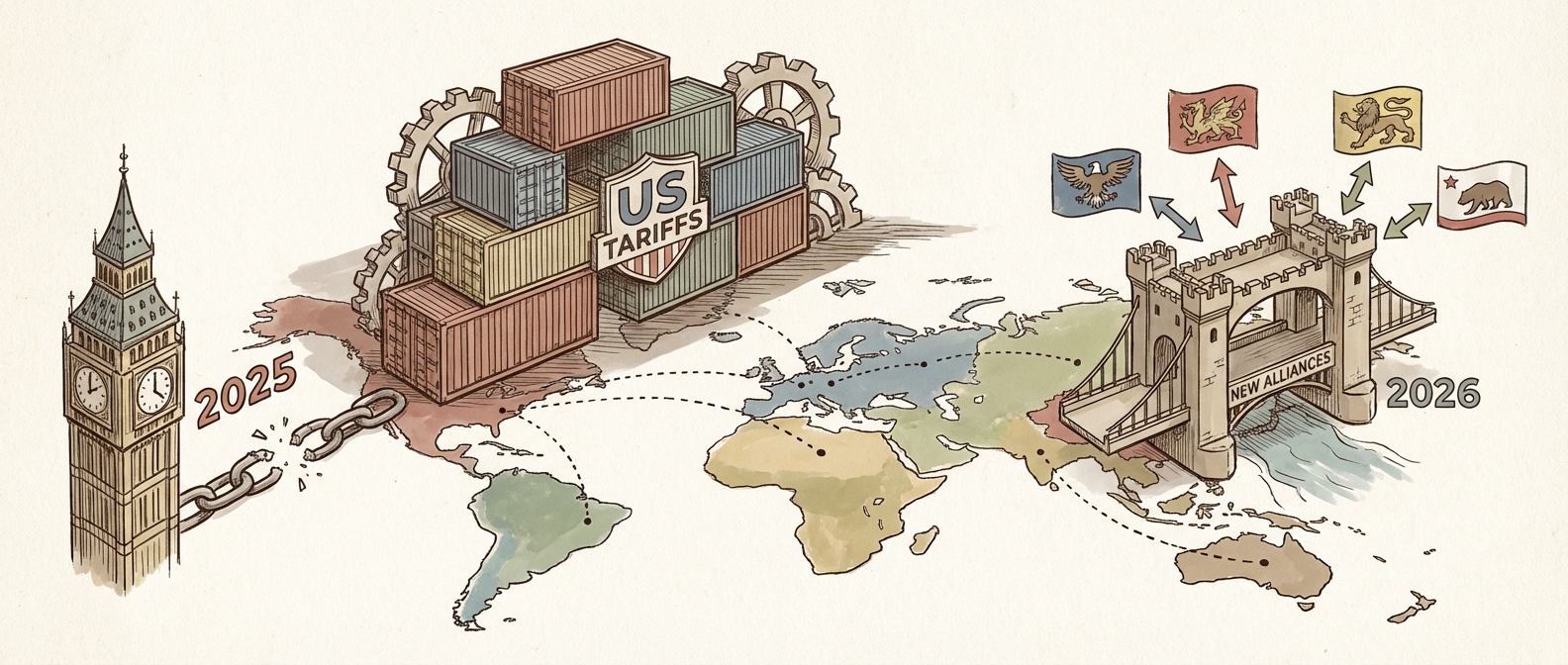
On April 2, 2025, President Trump stood before cameras and announced what his administration called “Liberation Day” – a sweeping tariff regime designed to fundamentally reshape American trade relationships. The specifics were striking: a baseline 10% tariff on virtually all imports, with duties on Chinese goods climbing as high as 145%. It was framed as economic nationalism, a corrective to what the administration characterized as decades of unfair trading practices. And here’s what matters for our purposes: it was real policy, implemented immediately through executive authority, without needing congressional approval.

Trump's Second-Term Tariff Gamble: What 2025's Trade War Actually Cost Us
Trump’s Second-Term Tariff Gamble: What 2025’s Trade War Actually Cost Us

I want to be direct about something before we go further. I understand the appeal of this approach. There’s a legitimate argument embedded in tariff policy – that American workers have absorbed real costs from global supply chains, that manufacturing capacity matters for national security, and that past trade agreements may have shortchanged certain regions and industries. These aren’t fringe concerns. They’re felt deeply in communities that have watched factories close. But we have to separate the intuitive logic of protectionism from what actually happened when this particular version hit the global economy.

The Household Income Question We Can’t Ignore

The Peterson Institute for International Economics ran the numbers on what this tariff package would mean for ordinary American households. Their conclusion: an average reduction in real household income of $2,600 annually. That’s not a talking point from opposition economists. The Peterson Institute isn’t a partisan operation. It’s a respected research institution that has analyzed trade policy across multiple administrations. This estimate accounts for increased consumer prices, reduced investment, and slower wage growth – the real mechanisms through which tariffs filter down to family budgets.

When you think about that $2,600, multiply it by the median American household. That’s money that doesn’t get spent at local restaurants. It’s the holiday gifts that don’t get purchased. It’s pressure on monthly budgets that were already stretched. The administration’s counter-argument was always that tariffs would protect American jobs, that the short-term pain would yield long-term gain. That’s worth examining seriously – except the job creation never materialized at scale in 2025. Manufacturing employment remained largely flat through the year, while inflation ticked upward in sectors heavily dependent on imported inputs.

How Our Allies Responded – And Why It Mattered

The Trump administration’s tariff strategy assumed that America’s trading partners would quickly capitulate, recognizing American economic leverage. Instead, the European Union launched retaliatory counter-tariffs on approximately 21 billion euros worth of American goods. The EU didn’t do this reflexively – they were quite measured about it – but they did it. Then came the 90-day truce negotiated in May 2025, which sounds like victory until you realize that 90-day truces are emergency measures, not durable solutions.

China’s response was more severe. They implemented retaliatory tariffs that reached 125% on American agricultural exports. Think about what that means for a farmer in Iowa or the Dakotas. Their products suddenly cost two and a quarter times as much in China’s market. Beijing wasn’t negotiating in good faith on this one – they were imposing costs designed to create domestic political pressure on the Trump administration. And it worked. By mid-2025, the USDA committed emergency aid packages exceeding $14 billion to farm states. American taxpayers were writing checks to offset tariff damage. The supposed market solution became a government bailout.

The Global Picture – and What We’ve Learned About Trade

By the fourth quarter of 2025, the International Monetary Fund released its World Economic Outlook. The headline finding: they downgraded global GDP growth projections by 0.8 percentage points. That may sound technical, but it translates to hundreds of millions of people affected. The IMF specifically attributed this revision to trade fragmentation resulting from the American tariff regime. We’re talking about measurable damage to the global economy – not theoretical, not speculative, but tracked and quantified by institutions that monitor these things professionally.

Here’s the uncomfortable truth that honest analysis requires: the tariffs did cause some reshoring of manufacturing. Companies did begin relocating production back to the United States in certain sectors. That part of the theory actually worked. But it happened in a narrower range of industries than promised, the jobs created paid less than the jobs lost in sectors dependent on imports, and the overall economic impact was negative – significantly negative – for most American households.

What This Teaches Us About Power, Policy, and Consequences

I came to this topic wanting to be fair to the protectionist argument because I think it deserves more serious consideration than it often receives in mainstream discussion. There are genuine questions about trade policy, about which arrangements serve American interests, about whether globalization has been managed equitably. These aren’t settled questions. But 2025 taught us something concrete about how tariffs work in practice: they impose costs immediately and visibly, while their benefits tend to be diffuse and delayed. That’s not an argument against tariffs; it’s an argument for implementing them carefully, with genuine consultation, and with realistic expectations about their effects.

The April 2025 tariff architecture reshaped global trade alliances partly through design and partly through accident. It accelerated the development of alternative trading blocs – the EU strengthened relationships outside the American sphere, China deepened ties with Southeast Asia and India, and the presumption of dollar-based trade superiority got seriously challenged. Whether that’s good or bad depends on where you sit and what you value. But it’s real.

What I keep coming back to is this: the communities that most needed economic revitalization didn’t get it from tariffs. They got inflation and, when the pain became politically untenable, government checks. Meanwhile, consumer prices rose. Businesses that relied on imported components faced genuine hardship. And the global economy contracted measurably. For those who believed tariffs would restore American manufacturing dominance and protect working communities, the 2025 results were at best partial victories wrapped in a larger economic slowdown.

I’m curious about your take on this. Did you experience these tariffs directly? Did your community’s job market shift, or your grocery bill, or your view of trade policy? The data tells one story, but lived experience tells another. That conversation – between evidence and experience – is where real democratic deliberation happens, and it’s what I want to keep exploring here.

Germany’s February Election and Merz’s First 100 Days: What a Centrist Comeback Tells Us About European Democracy

The Election Nobody Expected to Be This Close

When Friedrich Merz’s CDU/CSU crossed the finish line on February 23, 2025, with roughly 28.5 percent of the vote, the media narrative immediately shifted to “strong mandate.” That framing deserves scrutiny. Yes, this was the party’s best showing in over a decade. Yes, Merz earned his shot at chancellorship. But here’s what matters more: nearly 72 percent of German voters rejected his party. That’s the real story that got buried under headline writers celebrating a conservative rebound.

What made this election genuinely fascinating wasn’t the CDU/CSU victory. It was what happened to everyone else. The AfD captured roughly 20.8 percent of votes, a historic high that sent genuine shivers through European capitals. This wasn’t fringe politics anymore. This was a bloc that actually competed for second place and won it, reshaping every conversation about coalition mathematics before a single government was formed. When a country’s second-largest vote-getter is a party most established politicians refuse to work with, you’re operating in entirely new political territory.

The Coalition That Had to Happen

Let me be direct: Merz didn’t want to govern with the SPD. He never campaigned for that scenario. His preferred partner would have been the Greens, a coalition that would have signaled a kind of forward-thinking centrism. But the Greens underperformed, and the arithmetic forced him into the Social Democrats’ arms. The formal confirmation of their coalition in April 2025, delivering a 328-seat Bundestag majority, wasn’t a love match. It was necessity dressed up in diplomatic language.

This matters because coalition governments in parliamentary systems reveal truth through their constraints. Merz could push his preferred policies only as far as his SPD partners would tolerate. On economic policy, that meant real compromise. On social issues, it meant moving slower than his base wanted. This is how democracy actually works, not as winner-takes-all, but as constant negotiation. If you’ve ever watched city council meetings where the majority party still has to trade favors to get things done, you understand the texture of what happened here.

The Constitutional Earthquake: Suspending the Debt Brake

Here’s where the first 100 days got genuinely consequential. In March 2025, Merz’s government executed a move that would have seemed politically suicidal just years earlier: suspending Germany’s constitutional debt brake to fund a €500 billion infrastructure and defense package. For context, that debt brake, the Schuldenbremse, isn’t just policy. It’s constitutional theology in Germany, treated with the reverence Americans reserve for the Second Amendment. Breaking it required a two-thirds supermajority vote.

The case for doing this was straightforward. Europe’s industrial capacity needed modernization. NATO allies were demanding Germany pull its weight defensively. The infrastructure needed investment. But the intellectual backlash from conservative economists was fierce and deserved serious engagement. They argued that suspending constitutional guardrails, even for reasonable purposes, sets precedents that outlast any particular government. Once you’re comfortable breaking your fiscal constitution, what stops the next government from doing it for less defensible reasons? This isn’t fearmongering. This is how institutional decay typically begins, with reasonable exceptions that become the rule.

You can view this move two ways, and I think both views hold water. First reading: Merz showed genuine leadership by prioritizing European security over domestic political comfort, making hard choices that transcended partisan advantage. Second reading: Merz abandoned fiscal conservatism, the intellectual core of his coalition’s identity, and opened a door he can’t close. The truth probably sits in the tension between these readings. The €500 billion package wasn’t frivolous. But the manner of its passage did matter, regardless of its merits. Merz government’s €500 billion spending package — Deutsche Welle documented the legislative path that reflected both genuine consensus and genuine strain.

What Germany’s Defense Transformation Signals to Europe

The Bundeswehr’s budget is now on track to reach 3 percent of Germany’s GDP by 2027, exceeding NATO’s 2 percent benchmark. This is a real shift. Germany’s post-1945 strategic identity centered on economic integration, not military expansion. That identity wasn’t a choice made lightly, it emerged from genuine moral reckoning. Watching that identity change under pressure from Russia’s actions and American diplomatic pressure says something profound about how geopolitics can reshape even the most deeply held national commitments.

Merz’s willingness to accelerate this shift reveals his actual political priority: positioning Germany as a serious military power within Europe. Whether you think this is wise or reckless depends partly on your assessment of Russian intentions and partly on your philosophy about how democracies should organize their security. But notice what this means concretely: German soldiers will operate in more places, with more equipment, backed by larger budgets. That reshapes European military capacity in measurable ways.

What This Means for Democracy Watchers Like Us

So what do Merz’s first 100 days actually tell us about European politics in 2025? I’d argue three things. First, centrist parties can still win, but they win smaller than before. The CDU/CSU’s 28.5 percent would have been considered disappointingly narrow a generation ago. Second, far-right parties have achieved electoral legitimacy in the west’s largest economy. That’s a threshold we’ve crossed. Third, governing coalitions now require real trade-offs, and clear mandates are becoming rarer.

The fascinating part, if you pay attention to how these systems actually work, is that constraints aren’t always weaknesses. Merz couldn’t simply impose his vision. He had to negotiate. That friction produced compromises, some defensible and some questionable. That’s democracy operating as designed, messy, difficult, but fundamentally pluralistic.

What’s your read on this? If you’ve been following German politics closely, I’m genuinely curious whether you see Merz’s approach as wise recalibration or worrying precedent-setting. Have you watched how your own local government handles coalition dynamics or fiscal constraints? The same patterns play out everywhere, just at different scales. Germany’s 2025 election results — Federal Returning Officer provides the raw data. What conclusions do you draw from it?

The AI Governance Divide: Why Europe’s Bold Bet Matters Even if America Isn’t Following

Two Roads Diverged, and the World Is Watching

There’s a moment in every policy debate where you can see the future branching into different possibilities. We’re in that moment right now with artificial intelligence regulation, and it’s genuinely thrilling to watch, even though the stakes are uncomfortable to think about.

The AI Governance Divide: Why Europe's Bold Bet Matters Even if America Isn't Following
The AI Governance Divide: Why Europe’s Bold Bet Matters Even if America Isn’t Following

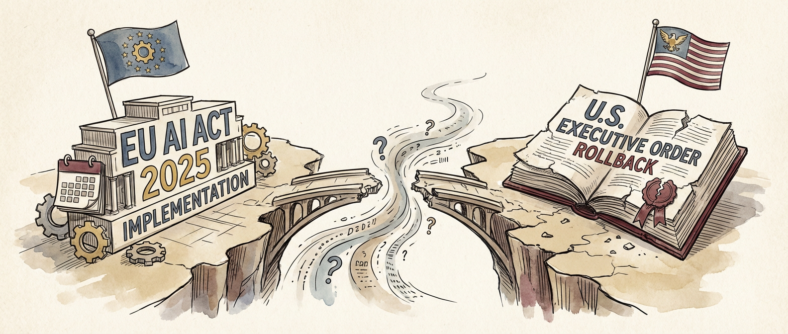
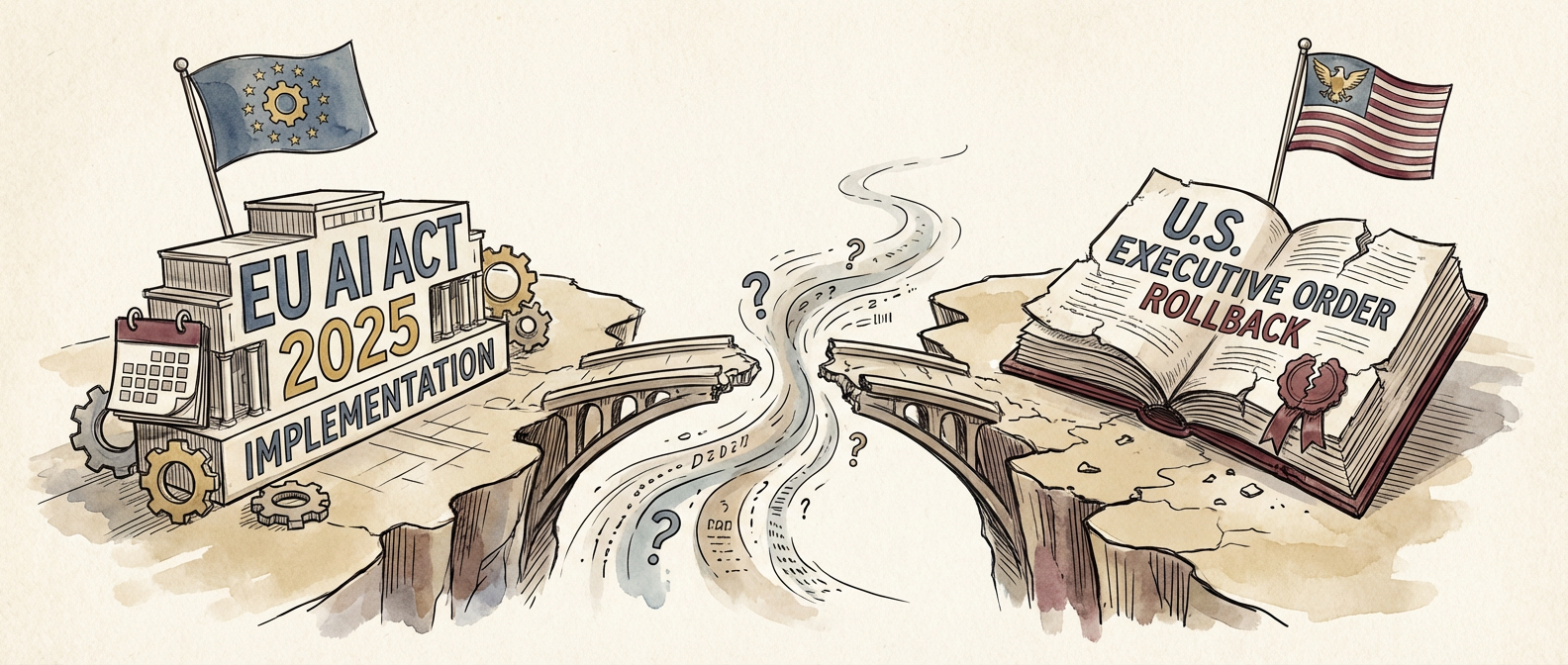
The European Union just crossed a significant threshold. Starting in August 2025, the EU AI Act’s requirements for high-risk AI systems moved from theory to enforcement. Companies deploying AI in employment decisions, educational settings, and critical infrastructure now face real obligations: they need to conduct conformity assessments, maintain detailed transparency documentation, and put human oversight mechanisms in place. These aren’t suggestions. They’re rules with teeth. The EU AI Office, established in 2024 to administer this framework, has already fielded over 200 formal complaints about general-purpose AI model providers in its first year. The machinery of governance is actually running.

Meanwhile, across the Atlantic, the machinery shifted into reverse. In January 2025, the Trump administration rescinded President Biden’s October 2023 Executive Order on AI Safety. That order had created federal safety reporting requirements for frontier AI models and established a precautionary approach to emerging risks. The new direction prioritizes competitiveness and directs federal agencies to think twice before regulating AI. It’s not that America rejected AI governance entirely, but it chose a fundamentally different path.

Illustration for The AI Governance Divide: Why Europe's Bold Bet Matters Even if America Isn't Following
Illustration for The AI Governance Divide: Why Europe’s Bold Bet Matters Even if America Isn’t Following

Why the EU Went Forward When Others Held Back

To understand what happened, you need to remember that the EU has been burned before. When social media exploded, Europe watched American companies operate with minimal constraints for years before anyone seriously tried to regulate. The EU learned from that experience. When AI started getting serious attention in policy circles, European officials asked themselves a simple question: why make the same mistake twice?

The EU AI Act represents a specific choice about values. It says that when a technology can meaningfully affect your employment status, your educational opportunities, or the safety systems that protect you, society has the right to know how that technology works and to verify it’s working fairly. This isn’t anti-innovation rhetoric, though you’ll hear that argument often. It’s a decision about where to draw the line between market freedom and democratic accountability.

The conformity assessments and transparency requirements that kicked in this year aren’t bans. They’re documentation requirements and mandatory human review for specific high-risk scenarios. A company can still deploy AI in hiring, but they have to show their work. They have to build in checkpoints where a person can override the system. Guardrails, not roadblocks.

China took yet another approach. The Cyberspace Administration issued its third major generative AI update in 2025, maintaining its system of mandatory algorithm registration while approving hundreds of domestic LLM deployments. China’s regulatory model emphasizes control and domestic development. It’s different from both Europe’s approach and America’s deregulatory turn, but it’s undeniably intentional governance.

The Competitiveness Question Everyone’s Actually Asking

Here’s where intellectual honesty matters. The American rollback of Biden’s executive order rests on a real concern: if we regulate ourselves into a corner while competitors don’t, we lose the race for AI dominance. There’s genuine merit to that worry. According to the Stanford HAI Artificial Intelligence Index Report, the United States and China together accounted for over 70 percent of significant AI model releases in 2024. Europe’s not even close to competitive at that scale.

The argument goes like this: stringent regulations mean higher compliance costs, which means smaller companies struggle, which means consolidation around a few big players who can afford lawyers and compliance departments. Meanwhile, American and Chinese companies either don’t face those costs or face them in different ways. The result could be that European innovation gets squeezed out, and Europeans end up importing AI systems built by foreigners under foreign rules. That’s not a conspiracy theory. That’s a plausible economic outcome.

But here’s the counterargument, and it’s equally legitimate: if you don’t set standards early, they get set by whoever builds the most powerful system first. The companies with the most resources and the least accountability get to define what’s acceptable. Is that better than the regulatory burden approach? Possibly not. The EU’s bet is that transparent rules applied uniformly create space for responsible innovation, even if it means slower growth initially.

These are real tradeoffs. They’re not resolved by insisting one side is simply right and the other is simply wrong. That’s the stuff of mature political debate.

What the Complaints Tell Us About Implementation

The EU AI Office received over 200 complaints about general-purpose AI model providers in its first operational year. That number is fascinating because it tells you something crucial: regulatory frameworks only matter if people actually use them. Those complaints didn’t have to happen. But they did, which means at least some portion of the EU market understands the rules exist and believes violations are worth reporting.

The specific content of those complaints probably matters more than the number. Are they about systems deployed without proper assessment? Transparency failures? Human oversight gaps? The EU hasn’t publicized detailed complaint categories, but early indications suggest they’re touching real governance problems, not abstract theoretical concerns. This is messy, unglamorous enforcement work. It’s also the foundation of any regulatory system that actually functions rather than merely exists on paper.

The EU AI Act Official Text and Implementation Timeline laid out a staggered approach, with different requirements kicking in at different times. The high-risk system obligations in August 2025 are just the first major implementation wave. As companies adapt and the enforcement mechanisms mature, we’ll learn a lot about whether this regulatory model actually works in practice or whether it creates bureaucratic theater without real protection.

The Real Question: Does Europe’s Approach Shape Global Norms or Just European Constraints?

This brings us to the deepest question. In a globalized technology market, does one region’s strong regulation become the de facto global standard because companies adopt it everywhere to simplify compliance? Or does it just create friction for European companies while American and Chinese competitors operate elsewhere under looser rules?

Historical precedent is mixed. GDPR became globally influential because many international companies found it easier to apply GDPR standards worldwide than to maintain different privacy regimes in different markets. But GDPR also consolidated power toward larger companies that could afford compliance infrastructure. Smaller players faced genuine barriers.

With AI regulation, the outcome is genuinely uncertain. The technology is still evolving. The market is still forming. The regulatory landscape is still being drawn. What we’re watching in 2025 isn’t the final shape of global AI governance. It’s the crucial early moment where different regions are making foundational choices about how they want their societies to relate to artificial intelligence.

The EU chose transparency and human oversight. America chose competitive priority. China chose state oversight combined with domestic deployment encouragement. None of these choices is obviously wrong or obviously right. They reflect different values, different risk tolerances, and different assumptions about how technology develops and how markets work.

If you care about how your country approaches these decisions, now is the time to actually pay attention. Not because one position is obviously correct, but because these choices are being made right now by people who are actually accountable to processes. That’s what democracy looks like in action, even when it’s messy and uncertain. What aspects of AI governance matter most to you, and why? I’d genuinely like to know how you’re thinking about these tradeoffs.

Friedrich Merz and the European Center-Right Reboot: What Germany’s February Election and First 100 Days Reveal About Money, Migration, and Power

The February Surprise That Wasn’t Quite a Surprise

On February 23, 2025, German voters handed Friedrich Merz and his CDU/CSU alliance their strongest federal result in over a decade. The coalition captured approximately 28.6% of the vote, a genuine mandate by contemporary European standards. If you’ve been following German politics, you probably expected the center-right to perform well. What might have caught you off guard was how the entire architecture of German coalition-building shifted beneath everyone’s feet.

The real story wasn’t just that Merz won. It was who came second and what that meant for how Germany’s new government would actually govern. The AfD finished with roughly 20.8% of the vote, their strongest-ever federal result. That’s not just a political data point. That’s a structural constraint on every coalition negotiation that followed. When roughly one-fifth of your electorate has voted for a party that every other party refuses to work with, your coalition options narrow dramatically. The political economy of German governance had shifted.

Here’s where I want you to think like a budget analyst rather than a poll-watcher. A 28.6% result sounds solid in isolation, but in a fragmented parliament, it’s actually a thin margin. Merz needed partners immediately. The question wasn’t whether the CDU/CSU would lead the next government. The question was which coalition math would determine the agenda for the next four years.

The Greenless Coalition and What Money Really Reveals About Politics

By April 2025, Merz had secured a coalition agreement with the SPD, Germany’s center-left Social Democrats. Here’s what made this genuinely noteworthy: it was the first time since 2005 that Germany’s government formed without the Greens at the table. That’s two decades of political history that suddenly broke.

Why does this matter beyond the ceremonial handshakes? Follow the incentives. The SPD, having come in third, could have leveraged a three-way Ampel (traffic light) coalition with the Greens and CDU/CSU. That’s traditionally how German center-left and center-right power-sharing works. Instead, Merz negotiated a straightforward two-partner coalition. This tells you something crucial about what the SPD leadership actually wanted: they wanted to distance themselves from the Greens while maintaining government relevance. They wanted to look tough on certain issues. And Merz was willing to offer them ministerial positions and policy concessions to make that mathematics work.

The coalition agreement itself is where political economy becomes concrete. In March 2025, just weeks into Merz’s chancellorship, the new government announced a €500 billion infrastructure and defense investment fund. Think about what just happened here. Germany, the country famous for strict fiscal discipline and its constitutional debt brake limiting new borrowing to 0.35% of GDP, just authorized massive spending by essentially sidestepping that very brake through a special fund structure.

This wasn’t accidental. This was the coalition’s way of signaling that spending priorities had shifted. The money was nominally for infrastructure and defense, but the real message was about who benefits when government decides to open the fiscal spigots. Construction companies, defense contractors, and infrastructure developers suddenly had access to capital they hadn’t seen in years. The SPD got to say they fought for workers and modernization. The CDU/CSU got to say they prioritized security. Everyone’s political incentive aligned.

Migration, Approval Ratings, and the Limits of Coalition Power

Fast forward to late 2025. According to Politico Europe: German Government Tracker, CDU/CSU approval ratings hovered near 30% despite having just won an election. That’s not actually unusual in Germany’s political system, but it reveals something important about what happened in those first hundred days.

Migration policy dominated the domestic debate. Merz, who built his political identity on stricter immigration enforcement, made tough rhetoric on asylum a centerpiece of the coalition agreement. But here’s where incentives get complicated. The SPD needed to show they weren’t abandoning their party’s traditional concern for refugee rights and humanitarian issues. The coalition’s public statements often pulled in opposite directions. Merz would call for stronger border controls. SPD ministers would emphasize integration programs. Voters watching this performance understood that neither party fully controlled the agenda.

The approval rating stagnation reflects that tension. You can’t be everything to everyone, and by late 2025, the Merz coalition was trying. They promised security spending without raising obvious taxes. They promised migration control without dismantling the asylum system entirely. They promised infrastructure investment while managing fiscal concerns. The result was a government that looked competent but uninspiring to much of its base.

What Merz’s First Hundred Days Tell Us About Center-Right Europe

Now let’s step back and ask what Germany’s political realignment means for European center-right politics more broadly. For decades, the template for European center-right governance was relatively stable: Christian democratic parties like the CDU/CSU would occupy the center, drawing support from business, professional classes, and religious communities. They’d form coalitions with liberal or green partners, manage slow-burn fiscal conservatism, and generally maintain the post-1989 consensus.

Merz’s coalition breaks with that template. By going SPD-only, the CDU/CSU signaled that traditional coalition partners had become optional. By spending half a trillion euros through a fund mechanism, they showed that fiscal orthodoxy was negotiable when it served security and infrastructure priorities. By making migration the defining domestic debate, they moved the Overton window rightward on an issue that had previously been more contested.

This matters internationally because other European center-right parties are watching. France’s Republicans, Spain’s People’s Party, and even segments of Italy’s center-right are all asking whether the Merz model offers a template for recapturing political ground from the far-right without ceding policy control to the left. The answer seems to be: maybe, if you’re willing to spend money strategically, drop old coalition partners, and make certain cultural issues non-negotiable.

Check out the actual election results yourself if you want the full data. The Federal Returning Officer: 2025 German Election Results has all the precinct-level detail you could want. But the real story isn’t in the spreadsheets. It’s in the coalition agreement language. It’s in which journalists have access to which ministers. It’s in how often the SPD’s Vice Chancellor had to publicly clarify what the Chancellor just said.

What This Means for Democracy Watchers Right Now

Here’s what I find genuinely important about tracking Merz’s chancellorship: it’s not a story about whether center-right politics is good or bad. It’s a story about how political incentives reshape what’s possible. When parties calculate that working together is more valuable than maintaining coalition traditions, they reshape those traditions. When governments find mechanisms to spend money despite fiscal rules, they change what “fiscal discipline” actually means.

If you want to understand European politics in 2025 and beyond, don’t just watch what politicians say about migration or defense or infrastructure. Watch who gets the contracts. Watch which ministers attend which meetings. Watch when the coalition partners issue joint statements versus separate clarifications. That’s where the actual incentive structure reveals itself.

The Merz chancellorship is still young, and plenty can change in the next few years. But in those first hundred days, we saw a center-right party successfully navigate a fractured political landscape by making strategic choices about partnerships, spending, and which issues to prioritize. Whether that model holds, whether it spreads across Europe, whether it ultimately strengthens or weakens democratic institutions, those are the questions worth following closely. What’s your read on how sustainable this coalition actually is? I’d genuinely like to hear what you’re observing in your own local and regional politics about similar tensions.

Netanyahu’s War Cabinet Crumbles: What Israel’s Political Collapse Means for Gaza’s Future

The Unraveling Coalition and What It Reveals

Here’s a question worth sitting with: What happens to a nation’s decision-making when the people making decisions stop believing in the same basic story about what they’re doing? That’s essentially what we witnessed in Israel’s political system through 2024 and into 2025, and it matters more than cable news segments tend to acknowledge. The emergency war cabinet that formed after October 7, 2023, was never meant to be permanent. Emergency coalitions are duct tape solutions. But when the duct tape fails, you see what was actually holding the structure together, and what was never supported at all.

In June 2024, Benny Gantz’s National Unity Party walked out of Netanyahu’s emergency coalition. This wasn’t a dramatic floor fight. It was quieter than that. Gantz, a former general with genuine security credentials, simply announced he couldn’t continue serving alongside Netanyahu without a clearer strategic plan for Gaza. The political math that followed proved instructive: polling through late 2025 showed Netanyahu’s Likud party consistently below 20 seats in a hypothetical 120-seat Knesset election. For context, that’s less than half what they held before the war. When your coalition partner leaves and your party’s support collapses by roughly 60 percent, you’re not managing a healthy political situation. You’re managing a crisis.

The Ceasefire Agreement and Its Complications

By January 2025, a ceasefire framework began taking shape through months of negotiation brokered by Qatar, Egypt, and the United States. The agreement involved a phased approach centered on hostage and prisoner exchanges. Phase 1 would see the release of 33 Israeli hostages in exchange for approximately 1,900 Palestinian prisoners held in Israeli detention. These are the kinds of numbers that seem abstract until you remember they represent actual people with families and histories and futures. That exchange ratio tells you something concrete about the bargaining positions involved and the humanitarian math both sides were working with.

What made this ceasefire diplomatically thorny wasn’t just the terms themselves. It was the backdrop of the arrest warrants issued by the International Criminal Court in November 2024. Both Prime Minister Netanyahu and then-Defense Minister Yoav Gallant faced charges including using starvation as a method of warfare. The International Criminal Court: Situation in the State of Palestine proceedings created immediate complications. Those ICC arrest warrants meant that Netanyahu and Gallant now operated under the constraint of potential arrest in any of 27 ICC member states. Diplomacy becomes substantially harder when the principals in a negotiation could theoretically face arrest if they traveled to cooperating countries. This wasn’t spin from either side. It was a documented structural problem that every negotiating party had to account for.

The Humanitarian Reality That Numbers Barely Capture

Let’s talk about what the actual situation on the ground looked like by early 2025, because this is where political abstraction meets human consequence. According to the UN OCHA: Humanitarian Situation Update — Gaza, the territory’s population of approximately 2.1 million people faced Category 5 famine conditions in the northern governorates. That’s the UN’s highest designation for food insecurity. The World Food Programme reported near-complete collapse of food distribution infrastructure. It wasn’t just that food was scarce. The systems that might deliver food, even if it existed, had essentially stopped functioning.

This matters politically because humanitarian catastrophe becomes a constraint on leadership decisions. You cannot indefinitely maintain military operations in a territory experiencing that level of collapse without it becoming the dominant political fact of your government. The humanitarian situation didn’t determine Israeli political outcomes by itself, but it absolutely narrowed the window for action and shaped the calculation of every political actor trying to maintain legitimacy. Gantz’s departure from the coalition occurred against exactly this backdrop of accelerating humanitarian deterioration.

The Economic Toll and Fiscal Reality

Economics rarely win headlines the way military operations do, but they often matter more to political stability. Israel’s Central Bureau of Statistics released figures showing the war’s direct costs exceeded 200 billion New Israeli Shekels, roughly $55 billion USD at 2025 exchange rates. That pushed the fiscal deficit to 8.1 percent of GDP for 2024, the highest level since 2002. These aren’t theoretical numbers. This is money that doesn’t go to schools, healthcare infrastructure, or development programs. It shapes whether your coalition members believe the strategy is sustainable at all.

When Gantz looked at the combination of mounting costs, stalled military objectives in Gaza, collapsing humanitarian conditions, and no clear political end-state, his calculation became clearer. You don’t have to be anti-Netanyahu to recognize that those variables don’t point toward a sustainable coalition government. They point toward a political crisis. And that’s exactly what developed.

What Comes Next: The Strategic Vacuum

Here’s the thing about political vacuums. They don’t stay empty. Something fills them. In Israel’s case, the collapse of the emergency coalition made new elections essentially inevitable, and the February 2025 campaign cycle arrived with a fundamentally weakened Netanyahu but no clear alternative coalition capable of commanding a majority. The Israeli political system faced the prospect of either fragmenting further or consolidating in ways that would dramatically reshape policy.

The ceasefire agreement, while established, operated within this context of political instability. A government with weakened coalition support and collapsed polling numbers operates differently than one with secure backing. You can see it in the decision-making speed, the willingness to make difficult compromises, the ability to weather criticism. Israel’s government faced all of these pressures simultaneously as 2025 progressed.

So here’s the thing: if you want to understand what’s actually happening in Israeli politics and policy in 2025 and 2026, skip the punditry about who’s winning or losing. Track the numbers instead. Watch coalition mathematics. Follow where the money goes. Read the actual ceasefire framework text. Look at the humanitarian reports. These are your real sources. This is how you build accurate political understanding instead of inheriting someone else’s narrative. Democracy, in Israel and everywhere else, depends on people willing to do this kind of careful reading. What are you learning when you look at the actual data?

The Great Pushback: How Governors Became the Gatekeepers of Immigration Enforcement in 2025

When Executive Orders Met State Sovereignty

We are living through one of those rare moments in American federalism when the textbook suddenly becomes a living document. In early 2025, as the Trump administration rolled out sweeping executive orders to expand interior immigration enforcement, something unexpected happened: governors started saying no. Not all of them, certainly, but enough to transform what looked like a straightforward expansion of federal power into a genuine constitutional standoff. By mid-year, at least eleven governors had issued executive directives essentially telling immigration enforcement agencies they could not freely operate using state resources or state law enforcement cooperation. California, Illinois, Colorado, and New York led this charge, but they were far from alone.

The Great Pushback: How Governors Became the Gatekeepers of Immigration Enforcement in 2025

This wasn’t theater. These weren’t symbolic gestures. When governors issue directives limiting their state police from assisting ICE operations, they are wielding real power. State law enforcement agencies employ roughly 880,000 officers nationwide. Without their cooperation, federal immigration enforcement becomes exponentially harder. This is the kind of constitutional tension that gets taught in civics classes as a hypothetical. Except it stopped being hypothetical about nine months ago.

Illustration for The Great Pushback: How Governors Became the Gatekeepers of Immigration Enforcement in 2025

The Legal Arsenal: When States Sue Back

Here is where the story gets properly interesting from a structural standpoint. The Department of Justice responded to these sanctuary directives exactly as expected: with federal preemption lawsuits against four states. The legal argument is straightforward from a textbook perspective. Immigration is federal authority. States cannot obstruct federal law enforcement. This is basic supremacy clause doctrine, and it has real weight in American constitutional law. Except the federal courts did not simply rubber-stamp the government’s position.

By July 2025, the U.S. District Court for the Northern District of Illinois issued a preliminary injunction that blocked portions of the federal enforcement directive itself. Let that settle in. A federal judge did not side with the states against the feds. Rather, the court found sufficient legal merit in the state arguments to impose restraints on how aggressively the federal government could pursue its own enforcement priorities. This is how constitutional disputes actually work when they are serious. It is not one branch defeating another. It is the judiciary stepping in to say: slow down, both of you need to stay within your actual authority.

What made this ruling significant was not that it invalidated federal immigration enforcement altogether. What mattered was that the court recognized the legitimate constitutional tension between federal immigration authority and state police powers. States have long held the power to decide how their officers spend time and resources. Can the federal government override that? The preliminary injunction essentially said: not so fast. We need to see the full legal record before settling this.

The Numbers Behind the Conflict

Numbers matter in policy debates because they ground ideology in reality. According to operational data released by the Department of Homeland Security in November 2025, ICE conducted over 185,000 interior arrests in fiscal year 2025, the highest annual total since 2011. That tells you how aggressively the federal enforcement machinery was operating, even with state cooperation diminished across a dozen states. The agency did not sit idle. It adapted and pressed forward using whatever resources remained available.

But here is where the empirical picture gets interesting. A September 2025 study from the Stanford Immigration Policy Lab Research team examined violent crime rates in counties with sanctuary policies compared to counties without them. The researchers found no statistically significant difference in violent crime rates between the two groups. This matters because one of the core arguments for strict enforcement has always been public safety. If sanctuary policies correlate with higher crime, that argument gains force. The Stanford researchers found no such correlation. They were not claiming that sanctuary policies reduce crime either. They found no measurable difference. This is the kind of empirical result that should shape policy conversations, even when it is inconvenient to one’s preferred narrative.

The Legislative Landscape: States Legislating Immigration

Beyond executive action and litigation, the real action unfolded in state legislatures. The National Conference of State Legislatures tracked 47 bills introduced in 2025 that dealt specifically with state and local enforcement of federal immigration priorities. Forty-seven bills. In a single year. Fourteen of them were signed into law. This tells you that governors were not acting alone in the shadows. They had legislative support, and they were building durable legal frameworks, not just temporary executive orders that could vanish with the next administration.

You can explore the full landscape of state immigration policy through the National Conference of State Legislatures: Immigration Policy Database, which tracks these developments with impressive granularity. What strikes you when you dig through that database is the sheer variety of approaches. Some states were tightening enforcement. Others were expanding protections. Still others were trying to thread a middle path. This is federalism working as the framers imagined it, even when it creates friction and legal uncertainty.

The Historical Parallel: Civil Rights and Nullification

Smart people who study American history keep returning to uncomfortable parallels. The most obvious one involves the civil rights era, when Southern governors and states attempted to use state authority to obstruct federal civil rights enforcement. That is a genuinely uncomfortable comparison because it involves using state power to block federal enforcement of individual rights protections. But it is not entirely parallel to what happened in 2025, and understanding why matters.

In the civil rights context, states were attempting to obstruct federal efforts to protect citizens from discrimination. In 2025, states were attempting to limit federal enforcement operations that swept up and detained noncitizens. These involve fundamentally different constitutional questions. One involves state obstruction of civil rights protections. The other involves state limitations on federal immigration enforcement. They are not identical moral or legal questions, even though both involve federalism conflicts.

What they do share is a structural reality: when state officials decide not to cooperate with federal enforcement, the federal government faces real constraints. During Reconstruction and the civil rights era, federal authorities pushed through despite state resistance because the moral stakes involved protecting American citizens from systematic discrimination. In 2025, federal immigration enforcement operated in a much more contested moral and legal landscape. That difference shaped how courts and the public received these conflicts.

What This Moment Actually Means

If you have been paying attention to your state and local government, you noticed something crucial about the 2025 immigration enforcement debates: they hinged almost entirely on power that states already possessed. States cannot prevent the federal government from conducting immigration enforcement on federal land or in federal buildings. But they can refuse to let federal agents use state facilities. They can instruct their own officers not to cooperate. They can decline to house detained individuals in state corrections facilities. These are not creative legal interpretations. These are straightforward applications of state authority that have always existed.

The reason this matters is simple. We often talk about federalism as an abstract constitutional principle. In 2025, it became a practical limiting force on executive power. Not because courts invented new doctrine or because Congress passed new laws, but because state officials exercised existing authority. This is how the constitutional system actually works when it works well. Power checks power. Different levels of government create friction and force negotiation.

You are living through a moment when civics matters in real time. If you want to understand what is happening in your state, look at what your governor and state legislature are doing with immigration enforcement. Look at what your county sheriff is deciding about ICE cooperation. Look at what your city council is saying about municipal resources. These decisions are not sideshows. They are where the Constitution actually lives.

Why the Gaza Ceasefire Collapse Reveals Everything About How Power Actually Works in 2026

The Moment Everything Changed: Phase Two and the Unraveling

Let me walk you through something that happened in early 2025 that most people missed, even though it was broadcast live to anyone paying attention. In January, negotiators finally got a ceasefire agreement across the finish line. Phase One was concrete: 42 days without fighting, 33 Israeli hostages released, Palestinian prisoners freed in exchange. It was the kind of deal that makes you believe humans can actually problem-solve under impossible pressure. But here’s what matters for understanding where we’re headed in 2026: Phase Two negotiations stalled by March. Completely stalled.

Why the Gaza Ceasefire Collapse Reveals Everything About How Power Actually Works in 2026

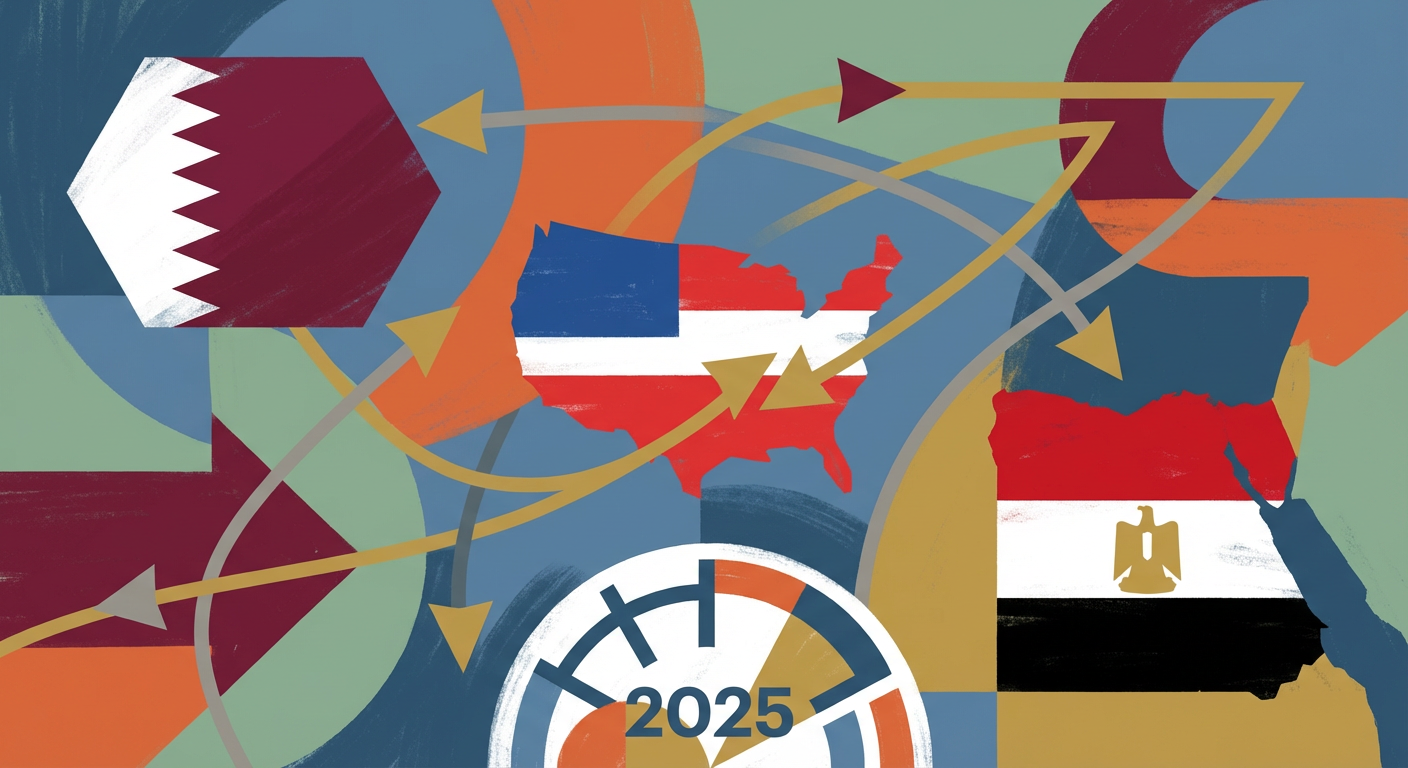
This wasn’t just another diplomatic setback. This was the moment when the real architecture of the conflict became visible. When Phase Two fell apart, it revealed something deeper than disagreement over terms. It showed how economic interests, geopolitical positioning, and military calculations actually determine what gets negotiated and what doesn’t. If you want to understand 2026 geopolitics, you need to understand why that happened.

Illustration for Why the Gaza Ceasefire Collapse Reveals Everything About How Power Actually Works in 2026

Follow the Mediators: Qatar, Egypt, and the Veto Power Nobody Talks About

Three countries spent 2025 trying to hold a ceasefire together that was crumbling. Qatar’s foreign minister Mohammed Al-Khatija conducted over 40 documented shuttle diplomacy trips. Forty trips. That’s not a side project. That’s a country betting significant diplomatic capital on preventing a regional war. Meanwhile, Egypt and the United States were simultaneously trying to mediate while protecting their own strategic interests. The economic calculation is pretty clear: Qatar has positioned itself as a regional power broker through years of investment in diplomatic infrastructure and relationships. A collapsed ceasefire damages that positioning. Egypt depends on Suez Canal revenue and regional stability. The United States has military assets and security commitments throughout the Middle East.

But here’s what’s revealing about the incentive structure: even with three major powers working overtime, even with constant shuttle diplomacy, the ceasefire’s second phase couldn’t hold. That tells you something crucial. The forces pulling toward resumed conflict were stronger than the forces pulling toward peace. In geopolitics, that’s almost always about what’s at stake economically and militarily for the major actors. When negotiations fail despite intensive mediation, follow the money and the military calculations, not the rhetoric.

The Security Council Vote Breakdown: Understanding American Veto Strategy

Between January and December 2025, the UN Security Council held nine emergency sessions specifically about Gaza. Let that sink in. Nine times. And three times during those sessions, the United States exercised its veto power on resolutions related to a permanent ceasefire. This is the kind of detail people gloss over, but it’s actually the clearest window into how power functions in practice.

When a permanent Security Council member vetoes a resolution, it’s making a public statement about costs and benefits. The U.S. vetoes were cast on resolutions aimed at permanent ceasefire arrangements. That means the calculations going into those decisions involved weighing the diplomatic cost of vetoing against something the administration deemed more important. Maybe it was security commitments to allies. Maybe it was concerns about the resolution’s language. Maybe it was signaling to regional partners about what terms the U.S. would accept. The point is, you don’t cast a veto unless you’ve decided that blocking international consensus serves an interest you consider worth protecting. Those three vetoes are data about what Washington’s actual priorities were in 2025, separate from what any official said publicly.

The Humanitarian Count: 2.1 Million People Dependent on Aid

In late 2025, the UN Office for the Coordination of Humanitarian Affairs reported that over 2.1 million Palestinians in Gaza remained dependent on international humanitarian assistance just to have food security. That’s not a prediction. That’s a documented humanitarian situation. You can check UN OCHA Gaza Humanitarian Situation Reports yourself and see the scale. This number matters for 2026 because humanitarian dependency creates political leverage and economic pressure. It creates refugee flows that affect neighboring countries. It shapes public opinion that affects governments. It creates moral claims that affect international law. When you have that many people dependent on food assistance, the calculus for any negotiator changes.

These 2.1 million people are not abstract statistics. They’re a fact on the ground that every mediator, every military planner, every diplomat has to account for. They affect what’s politically possible. They affect what regional allies will tolerate. And they affect what kind of pressure international actors face. When humanitarian dependency persists at that scale, it becomes part of the structural problem that any sustainable agreement has to address.

The International Court and the Genocide Convention Constraint

Here’s something else that was happening simultaneously with the diplomatic failure: the International Court of Justice issued two additional provisional measures orders related to the Gaza conflict in 2025. The March ruling specifically cited obligations under the Genocide Convention. You can review the actual legal proceedings at International Court of Justice: Gaza-Related Proceedings. These aren’t abstract legal documents. These are international rulings that create legal obligations and legal exposure for states.

When the ICJ issues provisional measures orders citing genocide convention obligations, it’s drawing a legal boundary around what kinds of actions carry potential consequences. That affects the calculations for any actor considering military options. It creates risk, potential accountability. Negotiations happening in 2026 are happening under legal constraint that didn’t exist in the same way before. States know there’s an international court reviewing their actions. That changes incentives at the margins, and margins matter.

What This Tells You About 2026 and Beyond

So here’s what the ceasefire collapse actually reveals about the year ahead: we’re in a period where the forces pushing toward negotiation exist simultaneously with strong incentives pushing away from it. Countries are investing heavily in mediation while also protecting their own strategic interests. Humanitarian dependency creates pressure for agreements while military and political calculations push back against them. Legal constraints exist now that didn’t before. And 2025 gave us a track record showing that even intensive mediation can fail to bridge those gaps.

The question for 2026 is whether any of those variables shift enough to change the outcome. Do new mediators emerge? Do economic pressures change? Do military calculations shift? Do domestic political changes in key countries create space for different decisions? These are the actual questions worth asking. Not whether people want peace. Of course they do. The question is whether the incentive structures align in a way that makes agreements possible and durable.

What do you think is the most significant constraint on peace agreements that we haven’t talked about enough? I’d genuinely like to know what patterns you’re seeing that I might be missing. This is the kind of question that gets clearer when people who care about this bring their own research and observations to it.

The 2026 Taiwan Midterms Are About More Than Elections — They’re a Pressure Valve We Need to Understand

Why Nobody’s Talking About the Real Tension Index

Here’s something that keeps me up at night as someone who genuinely cares about how democracies function under stress: Taiwan’s 2026 legislative midterms are shaping up to be far more consequential than the typical electoral cycle analysis suggests, and the conversation around them is missing a crucial dimension. We’re talking about elections happening against a backdrop of military escalation, declining domestic political confidence, and geopolitical pressure that most Western observers treat as separate variables. They’re not. They’re deeply interconnected, and understanding that connection might actually help us think more clearly about what’s genuinely at stake.

The 2026 Taiwan Midterms Are About More Than Elections — They're a Pressure Valve We Need to Understand
The 2026 Taiwan Midterms Are About More Than Elections — They’re a Pressure Valve We Need to Understand

Let me be direct about where I’m coming from. I’m not here to catastrophize or push any particular policy outcome. What I want to do is walk through the actual data and mechanics the way you’d examine a local budget before city council votes on it. Because that’s what this is, in a way — a budget of political capital being allocated under extraordinary circumstances, and the 2026 midterms are when Taiwan’s voters get to weigh in on whether they trust the current allocation strategy.

Illustration for The 2026 Taiwan Midterms Are About More Than Elections — They're a Pressure Valve We Need to Understand
Illustration for The 2026 Taiwan Midterms Are About More Than Elections — They’re a Pressure Valve We Need to Understand

The Domestic Pressure: Approval Ratings Tell a Story

President Lai Ching-te’s Democratic Progressive Party came into 2025 with what looked like a relatively solid governing position. They’d won the January 2024 presidential election, and Lai himself took office in May 2024 with genuine momentum. Fast forward to late 2025, though, and the Election Study Center at National Chengchi University, which runs the gold-standard polling operation in Taiwan, was recording approval ratings hovering around 38 percent. That’s not a collapse, but it’s a notable decline from where you’d expect a first-year president with control of the legislature to be sitting. You can check their latest public opinion data at the Election Study Center National Chengchi University Taiwan Public Opinion Data portal if you want to dig into the granular breakdowns yourself.

What matters about that 38 percent figure isn’t the number itself. What matters is what it tells us about voter confidence in the governing coalition’s strategy. When approval drops in a first term, especially when a party controls the legislative agenda, it usually signals one of two things. Either the government is delivering unpopular policies that voters understand and reject, or it’s failing to communicate a coherent strategy that voters can believe in during uncertain times. Taiwan’s situation involves elements of both, and that combination creates real vulnerability heading into 2026.

The External Pressure: When Military Exercises Become Political Messaging

Now let’s talk about what’s actually happening across the Taiwan Strait, because this is where the real tension index lives. In the spring and early summer of 2025, the People’s Liberation Army conducted what appeared to be the largest live-fire exercises in the strait since the August 2022 drills that followed Pelosi’s visit. We’re talking about something in the neighborhood of 90 naval vessels coordinated across three different PLA theater commands. This wasn’t a show of force in the abstract sense. This was a deliberate, observable military capability demonstration timed to send a message about Beijing’s readiness.

Here’s what I think matters about framing this correctly. These exercises weren’t a response to some specific provocation from Taiwan or the U.S. They were, in my reading, a calculated pressure tactic designed to influence Taiwan’s domestic political environment. When Beijing watches approval ratings decline and sees an opposition itching to criticize the government’s cross-strait handling, there’s an incentive to demonstrate that the current government’s approach isn’t keeping the island safe. Military exercises that remind voters of vulnerability serve that purpose. It’s not complicated, but it’s also not something most reporting on Taiwan focuses on when analyzing the correlation between military posturing and electoral politics.

The Hardware: Arms Sales and the Ammunition Question

In September 2025, the U.S. approved a $385 million arms package for Taiwan centered on advanced spare parts for F-16V fighters. Straightforward military aid, right? Beijing certainly thought it was worth a formal diplomatic protest and a temporary suspension of U.S.-China military-to-military communications. But here’s where the conversation gets more interesting and more honest than the standard takes allow.

The real vulnerability isn’t what most people think it is. Yes, Taiwan’s defense capability matters. Yes, F-16 spare parts are genuinely important. But look at what a late-2025 war-gaming update from CSIS found when they revisited their Taiwan Strait scenarios. The critical constraint in a high-intensity conflict isn’t hardware availability. It’s ammunition. Specifically, U.S. and allied ammunition stockpiles could be exhausted within 10 to 14 days of intensive combat operations. Read through their CSIS: Updated Taiwan Strait Scenario and Alliance Readiness Report 2025 analysis if you want the detailed breakdown, but the bottom line is this: we’re in a period where military capability exists but logistical durability doesn’t match the operational demands of the scenario everyone’s worried about.

What does that mean for Taiwan’s domestic politics heading into 2026? It means that voters who care about security, and in Taiwan, almost all voters do, are operating with a real understanding that military superiority isn’t guaranteed and that alliance relationships matter more than the hardware. That knowledge shapes how people evaluate whether the current government’s approach to cross-strait relations is working.

The Economic Shuffle: When TSMC Becomes a Political Indicator

There’s one more piece of this puzzle that almost nobody connects to electoral politics, but they should. TSMC, which manufactures approximately 90 percent of the world’s most advanced semiconductors below 3nm, announced plans for a third Arizona facility in 2025 while simultaneously ramping up its Kumamoto, Japan operations. This is being driven by American pressure for geopolitical diversification. Washington wants Taiwan’s most strategically important company manufacturing outside of Taiwan, in allied countries, because of war scenario concerns.

Think about what that means politically. Taiwan’s economy and geopolitical importance are being deliberately decoupled by design. That’s not conspiracy thinking. That’s explicit policy. And every Taiwanese voter understands, at some level, that their island’s economic leverage is being hedged against. The Lai government didn’t create this situation, but they’re governing in its context. When voters feel that their economic importance is being strategically downgraded, even if for security reasons, it affects how they evaluate leadership. It’s a subtle pressure, but it’s real.

Democracy Under Pressure Doesn’t Break Quietly

So here’s where I land after looking at all this, and I want to be honest about the tension in my own thinking. Taiwan’s 2026 midterms are happening in an environment where declining domestic approval, military pressure from Beijing, logistical vulnerabilities in security planning, and geopolitical economic hedging are all converging. Any one of those factors alone would make for an interesting election cycle. All of them together create a moment where democratic legitimacy becomes genuinely consequential.

I don’t think this is a moment for either panic or naive optimism. What I think it is a moment for serious attention to how democracies function when they’re under legitimate external pressure. Taiwan’s voters will make their 2026 choices based on whether they believe their government is managing these tensions competently and honestly. That’s how democracy works. That’s also how it survives, not because everything is comfortable, but because people get genuine voice in how discomfort is managed.

If you’re interested in Taiwan’s politics, move beyond the surface-level election coverage and dig into the actual data on public opinion, military posture, and economic strategy. Read what TSMC is doing. Look at the CSIS war-gaming analysis. Check the polling from the Election Study Center. Draw your own conclusions about what these midterms really mean. That’s how we all get better at understanding democracy in action, even when the stakes are genuinely high.

Mexico Under Claudia Sheinbaum: Democracy, Cartels, and the Weight of Historic Firsts

The Historic Inauguration and Immediate Constitutional Crisis

On October 1, 2024, Claudia Sheinbaum became Mexico’s first female president, a moment that genuinely matters for representation in a country where women have historically been locked out of the highest offices. But here’s what we need to grapple with as engaged observers: her inauguration day felt like the calm before a storm that broke almost immediately. Within weeks, MORENA’s congressional supermajorities began executing what amounts to the most sweeping judicial overhaul in modern Mexican history. By early 2025, the party had fundamentally restructured the federal judiciary through a reform that replaced sitting judges with an elected system designed to be more “democratic” in theory, but which has raised serious questions about judicial independence in practice.

Mexico Under Claudia Sheinbaum: Democracy, Cartels, and the Weight of Historic Firsts

The U.S. State Department didn’t mince words. They formally criticized the reform as undermining rule of law, a designation that carries real diplomatic weight. Now, you might hear different arguments on this issue, and they deserve consideration. Some argue that Mexico’s previous judicial system was itself undemocratic, controlled by an entrenched elite that didn’t answer to voters. That’s not wrong, historically speaking. But here’s the tension we have to sit with: when you replace an undemocratic system with one that concentrates power in legislative hands, you’ve potentially traded one problem for another. The fact that 65% of Mexico’s Supreme Court justices either resigned or declined to participate in the retention election suggests they saw genuine institutional danger ahead. That’s worth taking seriously, regardless of where you land on judicial reform philosophy.

Illustration for Mexico Under Claudia Sheinbaum: Democracy, Cartels, and the Weight of Historic Firsts

Cartel Sovereignty and the Limits of Presidential Power

If judicial reform represents Sheinbaum’s struggle with institutional consolidation, the security crisis represents something even more fundamental: the question of whether the Mexican state actually maintains a monopoly on legitimate force in significant portions of its own territory. In February 2025, the Trump administration designated six Mexican cartels as Foreign Terrorist Organizations, including the Sinaloa Cartel and CJNG. This wasn’t symbolic. The designation has direct legal consequences. It changes how financial transactions work, alters intelligence-sharing protocols, and shifts the threshold for U.S. military involvement. It’s an acknowledgment that certain criminal organizations now operate with state-like capacity in Mexico.

Consider the raw numbers on violence. The Wilson Center Mexico Institute Political Violence Tracker documented 47 sitting or recently elected local officials assassinated between January and October of 2025. That’s the highest rate recorded in their tracking period. These aren’t abstract statistics. These are elected officials, people who won democratic elections, who were then murdered specifically because they held office. This tells you something crucial about Sheinbaum’s governing environment: she inherited a presidency where significant portions of Mexican territory operate under parallel power structures controlled by organized crime. No president, however competent or well-intentioned, steps easily into that scenario. Sheinbaum came into office with a security strategy emphasizing “hugs not bullets,” a phrase that echoes her predecessor’s controversial pacifist approach. But when cartel violence continues at record rates, philosophical consistency collides with the practical demands of protecting citizens and elected officials.

The Border, Fentanyl, and Complicated Evidence

Here’s where things get genuinely complicated, the kind of complicated that should make us uncomfortable with simple narratives. U.S. Customs and Border Protection Fentanyl Seizure Statistics show that seizures reached 27,000 pounds in fiscal year 2025. That’s an enormous quantity of a lethal drug stopped at the border. Simultaneously, CDC preliminary estimates show that U.S. overdose deaths declined for the second consecutive year. So we have a paradox: more drugs being seized at the border, but fewer American deaths from overdoses. What do we do with that data?

One interpretation suggests that border enforcement efforts, even in an environment where cartels maintain significant operational capacity, are having measurable public health effects. Another interpretation notes that while seizures increase, production capacity far exceeds what’s being caught, meaning cartels can afford the loss and still maintain supply. Both interpretations contain truth. For Sheinbaum, this is a policy win she can point to while simultaneously highlighting the enormity of the challenge she faces. The U.S. wants results on the border. Her government can show results. But the underlying problem of cartel production and distribution remains largely unsolved. That’s the honest assessment.

MORENA’s Institutional Ambitions and Democratic Risks

Let’s be clear about what MORENA is and what it represents. The party won a genuine electoral mandate. Mexican voters chose them. MORENA controls the presidency and supermajorities in both chambers of Congress. That’s democratic legitimacy, and we shouldn’t dismiss it. But electoral victory and the responsible exercise of power are different things. The judicial reform shows MORENA consolidating control over institutions at a pace that historically precedes democratic backsliding. When a single party can reshape the judiciary, control the executive, and dominate the legislature without meaningful constraint, we’ve entered territory where democracy becomes formal without being substantive.

Sheinbaum has personally portrayed herself as a technocrat and scientist, someone guided by evidence rather than ideology. That’s a valuable self-presentation, but it gets tested when your party’s congressional leadership is moving faster than your stated preferences might suggest. The question becomes: how much is Sheinbaum the president setting her party’s agenda, and how much is she constrained by institutional dynamics larger than herself? That’s not a rhetorical question. Understanding the answer matters for predicting whether MORENA’s consolidation serves democratic deepening or represents a different path entirely.

What We’re Actually Watching

Mexico under Claudia Sheinbaum is a genuine inflection point. You have a democratically elected female president navigating institutional transformation, cartel violence that rivals some war zones, pressure from the U.S. government, and a political party with ambitions to reshape the state itself. These forces don’t move in compatible directions. Judicial independence and executive power concentration create tension. Cartel sovereignty and state capacity are fundamentally opposed. U.S. security expectations and Mexican sovereignty preferences sometimes align and sometimes directly conflict.

What makes this moment worth your sustained attention is precisely this complexity. We’re watching a test case for whether democracy can survive in a state where significant territory operates beyond its control. We’re watching whether institutional reforms can deepen democratic participation or whether they become tools for power consolidation. We’re watching whether a woman in Mexico’s highest office can navigate these pressures differently than her male predecessors, or whether the structural constraints are simply too massive. The honest answer is that we don’t yet know how these stories resolve. What we can do is pay attention with both rigor and intellectual humility. Follow the Wilson Center Mexico Institute Political Violence Tracker. Read Mexican reporting from outlets across the political spectrum. Ask yourself hard questions about what outcomes you hope for and why. That’s how citizens engage with distant democracies that matter to us. That’s where our actual responsibility lies.

Why Your Public Meeting Voice Matters More Than You Think (And How to Use It)

The Scene That Changed Everything

Picture this: It’s 1955 in Montgomery, Alabama, and a seamstress named Rosa Parks walks into a crowded city bus meeting. Not the bus itself—that moment comes later—but an actual public meeting where Black citizens are demanding better treatment from the city’s transportation department. Parks doesn’t just sit quietly in the back. She stands up, looks the all-white city council in the eye, and asks pointed questions about bus driver conduct and seating policies.

That meeting didn’t make headlines, but it laid important groundwork. Parks and others used those public forums to build relationships, gather intelligence, and practice the kind of direct engagement that would be essential months later during the bus boycott. They understood something we’ve forgotten: public meetings aren’t just bureaucratic theater. They’re democracy’s practice courts, where ordinary people learn to exercise real influence.

Show Up Like You Already Belong There

Walking into your first city council or school board meeting can feel like entering a foreign country where everyone speaks in acronyms and parliamentary procedure. Here’s the secret: most of those people felt exactly the same way during their first meeting. The difference between effective participants and intimidated observers isn’t knowledge—it’s preparation and persistence.

Start by reviewing the agenda beforehand. Every public meeting publishes one, usually on the organization’s website 24 to 72 hours in advance. Look for items marked “public comment” or “citizen input”—that’s your opening. If you see something you care about but don’t understand, call the clerk’s office and ask for background materials. They’re required to provide them, and most clerks genuinely want informed participants.

Arrive fifteen minutes early and introduce yourself to other attendees. Local politics runs on relationships, and that friendly conversation before the meeting starts often proves more valuable than the formal proceedings. Sarah Chen, who successfully advocated for bike lanes in her Portland neighborhood, credits those pre-meeting conversations with helping her identify unexpected allies and understand the real concerns behind opposing viewpoints.

Master the Art of Strategic Timing

Frederick Douglass once observed that “if there is no struggle, there is no progress,” but he also understood that timing could determine whether struggle leads to progress or merely frustration. Public meetings operate on similar principles. The most persuasive comment delivered at the wrong moment often carries less weight than a simple question asked at just the right time.

Public comment periods typically happen at the beginning or end of meetings, but the most strategic participants pay attention to the entire agenda. When council members debate an issue you care about, note their questions and concerns. If there’s a second public comment period later, you can address those specific points directly. This approach helped Maria Gonzalez transform her township’s approach to affordable housing. Instead of delivering a prepared speech about housing costs, she listened to the council’s budget concerns during their discussion, then used her comment time to present specific financing solutions that addressed their stated worries.

Don’t underestimate the power of showing up consistently, even when “your” issue isn’t on the agenda. Regular attendees develop credibility that newcomers lack. Council members begin to recognize you as someone who cares about community welfare generally, not just your particular cause. That recognition translates into real influence when issues you care about do come up for discussion.

Speak Truth With Strategic Precision

The most effective public meeting participants understand that passion without precision often backfires. You typically have two to three minutes to make your case—about the length of a brief news interview. Television journalists master this constraint by focusing on one clear point supported by one compelling example. Apply the same discipline to your public comments.

Consider how housing advocate James Thompson approached his city council. Instead of listing every problem with local housing policy, he focused on one specific issue: the six-month gap between housing application approval and actual assistance. He brought copies of constituent letters describing families living in cars during that waiting period, and he proposed one concrete solution—emergency bridge funding. The council approved his proposal three weeks later because they could visualize the problem and implement the solution.

Remember that elected officials are people, not position papers. They respond to stories, not just statistics. Combine your data with human impact, but keep both elements brief and specific. “Property taxes increased 23% while senior citizen incomes remained flat” hits harder than “taxes are too high,” but “My neighbor Mrs. Patterson may lose her home of forty years because of tax increases” creates the emotional connection that motivates action.

Build Beyond the Meeting Room

The real work of democracy happens between meetings, not during them. Public meetings provide the formal framework, but lasting change emerges from sustained relationship-building and strategic follow-up. Think of your meeting participation as one tool in a larger organizing toolkit, not a complete strategy by itself.

After effective public comments, expect to receive follow-up questions from council members, reporters, or other community members. Prepare for these conversations by developing deeper expertise in your issue and building coalitions with like-minded residents. The Nashville parent who successfully challenged standardized testing policies spent months after her initial public comment building relationships with teachers, other parents, and education researchers. When the school board finally reconsidered their policy, she had become the go-to expert, not just another concerned voice.

Document your advocacy efforts and results. Take notes on which arguments resonate with which officials. Track promises made during meetings and follow up on them consistently. This record-keeping transforms you from a periodic participant into a serious civic actor whose input carries weight because it’s informed, consistent, and accountable.

Democracy’s greatest strength lies not in its perfection, but in its capacity for ordinary people to create real change through sustained engagement. Your voice in that meeting room connects you to a tradition stretching from town halls in colonial Massachusetts to lunch counter sit-ins in 1960s Nashville. How will you use that inheritance?

How to Speak Up at Public Meetings Without Getting Steamrolled (Like Our Ancestors Did)

The Town Hall Echo Chamber Problem

Picture this: you walk into your first city council meeting fired up about that new development threatening your neighborhood park. You’ve done your homework, printed out studies, even practiced your speech in the mirror. Then you watch as speaker after speaker gets cut off mid-sentence, dismissed with a polite nod, or worse—completely ignored while council members scroll through their phones. Sound familiar? You’re experiencing what colonial-era town meeting participants knew all too well: the gap between democratic ideals and messy reality.

The difference is that those early New England settlers eventually figured out how to make their voices heard effectively. They developed tactics that modern meeting-goers can still use today. The key isn’t speaking louder—it’s speaking smarter.

Do Your Intelligence Gathering First

Before the Boston Tea Party, Samuel Adams spent months attending seemingly boring town meetings, taking notes on who supported what positions, and identifying potential allies. Modern civic participation requires the same strategic preparation. Start by watching a few meetings online or in person before you speak. Notice patterns: Does Councilmember Johnson always ask follow-up questions about budget impacts? Does Mayor Smith tend to support speakers who cite specific data?

Research the agenda item you care about using the same detective skills our predecessors used when they were fighting taxation without representation. Check meeting minutes from previous discussions of your issue. Look up campaign finance records to see who donated to current officials. Review the municipal code to understand what powers the body actually has. When you show up knowing more than half the room, people listen differently.

Most importantly, find out the exact rules for public comment in your jurisdiction. Some places limit you to three minutes, others to five. Some require you to sign up 24 hours in advance, others let you register when you arrive. Albany, New York requires speakers to submit their comments in writing beforehand, a rule that trips up newcomers who show up expecting to wing it.

Build Your Coalition Before You Need It

The Continental Congress succeeded because delegates spent years building relationships across colony lines before they needed to act together. Your local advocacy works the same way. Start showing up to meetings even when you don’t have a burning issue to address. Introduce yourself to other regular attendees during the break. Exchange contact information with people who speak on topics you care about.

When you do need to mobilize, you’ll have a network ready. Coordinate with allies to spread speakers across the meeting rather than clustering you all together. Plan complementary talking points. Have one person focus on environmental impact, another on economic concerns, a third on legal precedent. The planning committee for opposition to a controversial Walmart in Ashland, Oregon used this strategy effectively, with different speakers highlighting traffic, small business, and environmental concerns across three separate meetings.

Consider inviting decision-makers to meet with your group outside the formal meeting setting. Many officials prefer these one-on-one or small group conversations because they can ask questions without performing for cameras or constituents.

Master the Art of Strategic Timing

Revolutionary War generals knew that timing could make or break a campaign. The same principle applies to when you choose to speak up at public meetings. Avoid being the first speaker if possible—you’ll be setting the tone without knowing the room’s mood. But don’t wait until the end either, when attention spans have evaporated and officials are mentally checking out.

Pay attention to agenda placement. Items early in the meeting get more attention than those buried at the end. If your issue is scheduled late, consider asking allies to request it be moved up, or plan to attend multiple meetings rather than cramming everything into one marathon session.

Sometimes the most powerful moment to speak is when you disagree with the direction of the conversation. If everyone before you has made the same point, pivot to a different angle. If the discussion has gotten heated, be the voice of reason who acknowledges valid concerns from multiple sides while still advocating for your position.

Speak Like You’re Teaching, Not Preaching

The most effective speakers at public meetings channel their inner civics teacher rather than their inner activist. Think about Frederick Douglass, who changed minds by methodically dismantling pro-slavery arguments with logic and evidence rather than just moral outrage. Your three minutes should educate as much as advocate.

Start with a clear statement of what you’re asking for, not a long wind-up about why you’re there. Use specific examples that officials can visualize: “The proposed bike lane would eliminate 12 parking spaces on Oak Street, but it would create a safe route for the 200 students who bike to Jefferson Elementary every day.” Numbers and concrete details stick better than emotional appeals alone.

Practice the “Yes, and” technique borrowed from improv comedy. Acknowledge legitimate concerns raised by others while advancing your own position: “Yes, we all want to support local businesses, and that’s exactly why we need better public transit to bring customers downtown.” This approach builds bridges instead of burning them.

End with a specific, actionable request rather than a general plea. Don’t just ask officials to “do something” about housing affordability. Ask them to direct staff to research inclusionary zoning ordinances from similar cities and report back within 60 days.

Follow Through Like a True Organizer

The abolitionists didn’t disappear after giving one speech. They built sustained campaigns that lasted decades. Your civic participation should have the same long-term view. Send thank-you emails to officials who listened respectfully, even if they haven’t committed to your position yet. Share contact information with new allies you met at the meeting.

Most importantly, keep showing up. Attend the next meeting to see if your issue moves forward. Volunteer for committees related to your concerns. Run for office yourself if you’re ready for that level of commitment. The officials who seem unresponsive today might become allies tomorrow if they keep seeing your face and hearing your reasonable, well-researched points.

Democracy has always been a long game, whether we’re talking about the decades-long fight for women’s suffrage or the ongoing work of making local government actually responsive to residents’ needs. What tactics from your own meeting experiences have surprised you with their effectiveness?