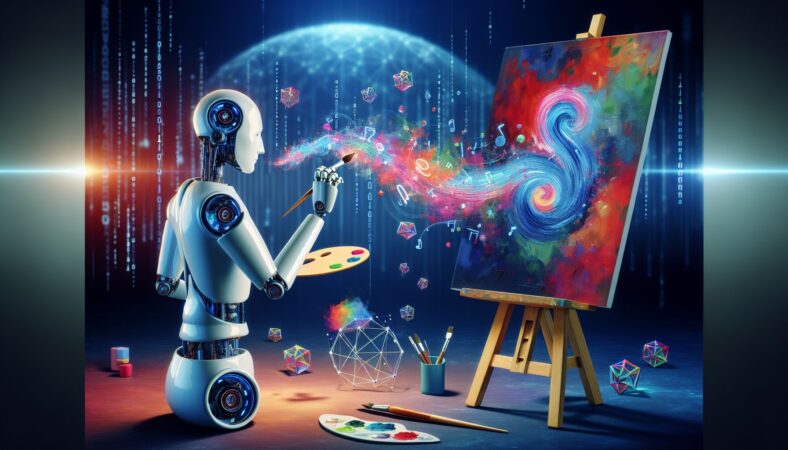
Good morning, techno-savvy mates! I’m beaming with excitement today because, confession time folks, I live and breathe for the mind-blowing intersection of technology and creativity. And right now, there’s a phenomenal play unfolding on that stage: Artificial Intelligence in creative arts. As a self-confessed tech and art buff, I feel like a kid in a candy store seeing my two loves embracing each other. Let’s jump in and explore this thrilling spectacle together!
AI Meets Art
Rewind to a few years back, could you have imagined a machine producing awe-inspiring artworks, writing soul-stirring poetry or composing mesmerizing music? If you’re like me, probably not. But here’s the kicker: it’s happening, and the results are nothing short of spectacular!
Whether we’re talking about paintings generated by Google’s DeepDream, or song compositions from OpenAI’s MuseNet, or even poetry spun out by the likes of GPT-3, creativity isn’t just for us squishy humans anymore. AI is jumping on the bandwagon, and folks, it’s pulling off some seriously fancy moves.
So is this techno-euphoria, techo-terror or simply techno-utopia? Stick around, as we get our hands in the AI-art cookie jar.
Behind the Easel: The Mechanics
But before we dive deeper into AI’s creative fancies, let’s spare a moment to appreciate the nitty-gritty. Remember, at the heart of these artistic AI marvels is a complex network of algorithms and computations, all designed and fine-tuned by a team of human engineers (hats off to them, really).
Neural networks, in particular, are a big deal here. They’re designed to imitate how our own human brains work, breaking down tasks into teeny-tiny pieces and processing them simultaneously. Technologies like DeepArt and DeepDream use convolutional neural networks to mimic artistic styles and create otherworldly images.
The Art of Knowing: AI’s Unseen Muse
You might be wondering, “What does AI know about art or creativity?” Well, the short answer: a surprising amount! These AI engines can consume vast swaths of text, music, or images. The more they ingest, the more they learn and understand patterns within those various art forms. It’s like wolfing down hours and years of art history, music theory, and literature classes in a split second. (And here I was, thinking I was special because I could play ‘Stairway to Heaven’ on my guitar, sigh)
The Picture So Far: AI in Visual Arts
Venturing into the realm of visual arts, we’ve got AI models creating unique paintings. DeepArt can turn your selfie into a Van Gogh-style masterpiece or DeepDream churning out psychedelic artwork that would make Salvador Dali do a double take. And who can forget the portrait generated by GANs-based engine, which was auctioned off for an astonishing $432,500 at Christie’s!
What’s fascinating to me is that AI doesn’t just imitate existing styles, it creates something entirely new by adding its own unique twist to it.
AI: The Budding Poet and The Maestro
AI doesn’t stop at visual arts. It’s making some serious noise in the realms of literature and music too. Whether it’s OpenAI’s GPT-3 penning an entire op-ed in ‘The Guardian’, or Jukin Media’s Lyrical creating catchy tunes, the AI is leaving everyone jaw-dropped. MuseNet, also developed by OpenAI, can compose original songs in the style of Mozart, the Beatles, or even Lady Gaga.
It’s like we’re looking at an unlimited, ever-changing, creative jukebox that knows almost every tune in existence and can recreate them with an astonishing degree of finesse.
The Uncanny Valley: AI’s Creative Dilemma
It’s not all roses, of course. Part of what makes art so powerful is its humanistic touch: the emotions, experiences, and the soul behind the brush strokes or the penned words. Can an AI truly replicate that depth? Or does it venture into the uncanny valley, where it’s almost human, but not quite, and that creates an eerie disconnect?
As someone who’s witnessed AI-created paintings and listened to AI-composed music, the difference is often subtle, but still noticeable. The small imperfections, the little human quirks, are what make art feel so alive to us, and AI has yet to replicate that.
Future Prospects: A Symphony of Humans and AI
Amidst all the awe and apprehension, I believe we are transitioning into an era of ‘augmented creativity’, where humans and AI will collaborate to discover uncharted territories of creative expression. Imagine a world where AI helps us push the boundaries of creativity, inspiring us in ways we’ve never imagined. Or conversely, AI creators learning from our human imperfections and randomness to create even more realistic and relatable art.
I don’t know about you, but I’m all geared up to dive into this future where man and machine jam together and rock the stage with superhuman creativity.
Unplugged
When push comes to shove, the debate on AI’s role in creative arts boils down to our definition of creativity. If you view creativity as the ability to produce work that’s both novel and useful, then AI is off to a roaring start.
But if creativity means pouring our souls onto a canvas or into a melody, then AI, despite impressive chops, still has a way to go. Either way, the creative sparks flying from this magnificent collision of art and AI makes for one heck of a tech symphony. And I can’t wait to see what the next act holds!
Break a leg, AI. We’re all rooting for you! Stay tuned and stay curious, friends. Until our next tech rendezvous!